
Why Behavioral Correlation Is the Biggest Risk in Multi-Account Automation
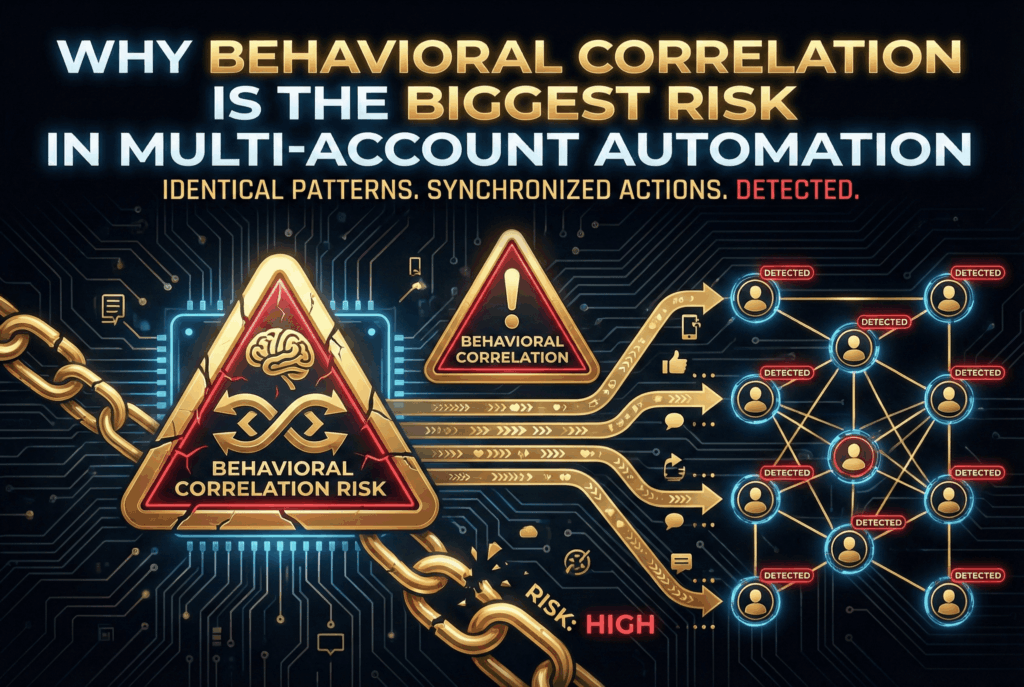
When agencies scale beyond ten Instagram accounts, risk changes form. It is no longer about individual violations or excessive activity. It becomes systemic. The true threat in large-scale operations is not volume. It is similarity.
In 2026, the biggest risk in multi-account Instagram automation is behavioral correlation. Algorithm updates have refined clustering models to detect not just aggressive actions, but repeating behavioral structures across account networks. When dozens or hundreds of profiles behave too similarly, they cease to appear independent.
Instagram does not penalize automation because it is automated. It penalizes automation when it becomes statistically uniform.
Understanding why behavioral correlation is dangerous—and how to architect against it—is essential for agencies managing scalable Instagram ecosystems.
Instagram No Longer Detects Actions — It Detects Patterns
One of the most dangerous misconceptions in multi-account Instagram automation is the belief that enforcement is triggered by isolated actions. Agencies often focus on numerical thresholds: how many DMs per day, how many follows per hour, how many comments per session. While volume can influence risk, modern detection systems are not built around static action limits. They are built around pattern recognition.
Instagram does not evaluate behavior in isolation. It evaluates sequences.
Every action—story view, like, DM, follow, reply, login—exists within a broader behavioral timeline. The platform analyzes how these actions connect, how frequently they repeat, and how similar they appear across accounts. When activity follows predictable structures repeatedly, the system assigns correlation weight.
This is the fundamental shift: it is not the action that creates risk, but the structure surrounding it.
For example, sending ten DMs in a day may not be problematic on its own. However, if those DMs consistently occur within the same time window, follow identical engagement activity, use similar phrasing, escalate after the same number of replies, and repeat across multiple accounts, the behavior becomes statistically clustered.
Clustering is the core of modern detection.
Instagram’s systems compare accounts against each other as well as against organic baselines. Real users behave inconsistently. They fluctuate in intensity. They respond at irregular intervals. They escalate conversations unpredictably. They log in at varying times. Their actions rarely follow clean, repeatable sequences.
Automation systems that prioritize efficiency tend to remove this natural inconsistency. They create clean workflows. Engagement precedes DMs in identical ratios. Conversations escalate at fixed message counts. Sessions begin and end within predictable windows. When this structure is replicated across dozens of accounts, it forms a detectable behavioral signature.
Even if each account appears compliant individually, the collective pattern exposes coordination.
Pattern detection operates across multiple layers simultaneously.
At the timing layer, the system evaluates synchronization. Do multiple accounts initiate similar actions within overlapping windows? Do they follow similar daily rhythms? Do activity spikes occur simultaneously?
At the structural layer, the system analyzes progression logic. Do conversations escalate after identical exchange counts? Are links introduced consistently at similar depths? Is engagement always followed by a DM within a narrow time frame?
At the linguistic layer, repetition amplifies correlation. Similar openers, similar emotional framing, similar call-to-action positioning create cross-account fingerprints.
At the session layer, login patterns and activity bursts further reinforce clustering signals.
When these layers overlap, pattern density increases. Detection does not require identical behavior. It requires measurable similarity across enough dimensions.
This is why traditional rule-based thinking fails in large-scale Instagram automation architecture. Agencies may remain within assumed “safe limits” for individual actions while unknowingly creating highly uniform behavioral ecosystems.
The danger is cumulative.
Patterns become more visible as scale increases. Five accounts with similar behavior may not trigger clustering thresholds. Fifty accounts with moderate similarity likely will. One hundred accounts with synchronized structures almost certainly create detectable correlation density.
The solution is not simply reducing activity. It is disrupting uniformity.
Diversifying timing, decentralizing escalation logic, introducing linguistic variation, and segmenting operational workflows reduce pattern overlap. When accounts no longer move in parallel, clustering models lose coherence.
Ultimately, Instagram’s enforcement systems are designed to detect networks, not mistakes.
An isolated action rarely defines risk. A repeated structure across accounts does.
Agencies that understand this principle stop optimizing individual actions and begin engineering behavioral ecosystems. They design automation that preserves natural variance rather than eliminating it.
In multi-account environments, patterns determine survivability.
Uniformity Amplifies Detection Risk at Scale
Uniformity is rarely visible at small scale. Across a handful of accounts, similar workflows may appear harmless. But as scale increases, similarity compounds. In multi-account Instagram automation, what seems operationally efficient at ten profiles becomes statistically dangerous at one hundred.
Detection systems operate on probability, not intuition. When dozens of accounts share aligned activity rhythms, mirrored engagement ratios, and synchronized messaging structures, the probability that those accounts are independent users drops sharply. This is where behavioral correlation risk begins to accelerate.
Uniformity amplifies detection risk because it increases pattern density.
Consider timing. If multiple accounts consistently initiate DMs within similar daily windows, follow similar session lengths, and exhibit parallel activity spikes, clustering models detect synchronization. Real users do not activate in coordinated waves. They log in unpredictably. Their energy fluctuates. Their activity intensity changes organically.
Now consider progression structure. If every account engages with content, waits a fixed interval, then sends a DM, and escalates intent after a similar number of exchanges, that structure becomes measurable. Even when message content differs slightly, the progression logic remains identical. At scale, structure matters more than wording.
Uniformity also manifests in engagement ratios. If accounts maintain near-identical follow-to-like ratios, consistent DM-to-engagement conversion rates, and similar daily activity ceilings, the ecosystem appears engineered rather than organic. Detection models are trained to identify statistical outliers, but they are equally sensitive to statistical clustering.
The larger the network, the more dangerous similarity becomes.
With five accounts, moderate overlap may remain below clustering thresholds. With fifty, the same overlap becomes statistically significant. With one hundred, uniformity transforms into a clear coordination signal. Scale magnifies even subtle repetition.
This is why standardized playbooks, while operationally attractive, create systemic fragility. Agencies often deploy identical automation workflows across every account to simplify management. Identical posting cadence. Identical messaging scripts. Identical escalation timing. This operational neatness produces algorithmic vulnerability.
Uniformity does not always trigger immediate restrictions. More often, it generates gradual friction. DM limits tighten inconsistently. Deliverability declines without obvious cause. Accounts encounter verification prompts at higher frequency. These are signs that similarity density is approaching enforcement thresholds.
Importantly, uniformity is not limited to messaging. It includes session patterns, login windows, engagement bursts, response timing, and even content interaction style. When these elements align too cleanly across accounts, cross-account detection models gain statistical confidence.
Breaking uniformity does not mean introducing chaos. It means engineering controlled diversity.
Timing dispersion reduces synchronization signals. Escalation variability disrupts structural overlap. Linguistic variation lowers fingerprint repetition. Activity intensity modulation prevents correlated spikes.
Uniformity is appealing because it simplifies operations. Diversity is essential because it protects scale.
In large-scale Instagram automation architecture, survivability depends less on how much activity occurs and more on how differently it occurs across accounts. The more accounts mirror one another, the stronger the clustering signal becomes.
Ultimately, scale does not create risk on its own. Scale amplifies similarity.
And similarity, when repeated across a network, is what transforms automation from efficient into detectable.

Correlation Extends Beyond Messaging
Many agencies assume that Instagram DM automation is the primary risk vector in multi-account systems. While direct messaging is highly sensitive, behavioral correlation extends far beyond the inbox. In reality, clustering models evaluate the entire behavioral ecosystem surrounding each account.
Messaging may be the most visible layer, but it is only one dimension of correlation.
Instagram analyzes how accounts engage with content, how frequently they log in, how long sessions last, how interactions cluster within time windows, and how activity fluctuates across days and weeks. When these dimensions align too closely across multiple profiles, coordination becomes statistically evident.
Engagement synchronization is one of the most overlooked risks. If dozens of accounts begin interacting with posts within similar timeframes, exhibit similar reaction patterns, and maintain comparable engagement intensity curves, pattern density increases. Real user ecosystems are noisy. Activity is scattered and inconsistent. Multi-account networks that move in synchronized blocks lack this natural dispersion.
Correlation also appears in session behavior. Accounts that log in and out at similar times, maintain nearly identical session durations, or trigger activity bursts in parallel create measurable overlap. Even without aggressive messaging, these timing alignments contribute to clustering confidence.
Content interaction style can amplify similarity as well. If accounts consistently engage with the same types of posts, within the same engagement depth range, and in comparable sequences, structural patterns form. Algorithmic systems evaluate not only what actions occur, but how those actions are distributed across the network.
Infrastructure-related behavior adds another layer. Shared environmental characteristics, similar login routing patterns, and overlapping device-level continuity signals reinforce correlation models. When behavioral similarity aligns with technical overlap, detection probability compounds.
Escalation logic further extends correlation risk. If multiple accounts introduce offers after similar conversation depth thresholds or apply identical pacing adjustments in response to platform changes, synchronized behavioral shifts become visible. Even strategic adaptations can become detection signals if implemented uniformly.
The key insight is that correlation is multidimensional. It emerges not from one repeated action, but from overlapping similarity across timing, engagement, messaging, session behavior, and infrastructure layers.
Algorithm updates refine these multidimensional clustering models incrementally. As pattern recognition becomes more precise, systems that previously relied on surface-level diversification become exposed. Diversifying only message content while maintaining synchronized engagement timing is insufficient.
Safe multi-account Instagram automation architecture must therefore diversify behavior holistically. Messaging, engagement rhythm, session cadence, escalation timing, and infrastructure signals must all operate with controlled independence.
This is why correlation is the greatest systemic risk. It does not originate from a single mistake. It emerges from structural repetition across layers.
Agencies that focus exclusively on safe DM limits while ignoring engagement synchronization remain vulnerable. Agencies that diversify messaging but maintain identical daily activity windows create hidden clustering signals.
True resilience requires recognizing that automation is evaluated as an ecosystem.
In scalable Instagram systems, correlation does not stop at the inbox. It flows through every measurable dimension of account behavior.
Behavioral Independence as Structural Protection
If behavioral correlation is the greatest systemic risk in multi-account Instagram automation, then behavioral independence is the strongest structural defense.
Independence does not mean randomness. It does not mean abandoning strategy or operating without centralized oversight. It means designing each account to function as a statistically credible individual rather than as a synchronized extension of a network.
Instagram’s clustering systems evaluate similarity density across accounts. When patterns overlap across timing, engagement ratios, messaging cadence, escalation logic, and session behavior, the network begins to resemble coordination. Behavioral independence lowers that similarity density across every measurable layer.
The first layer of independence is rhythm.
Each account should operate on its own activity tempo. Login windows should vary. Session lengths should fluctuate. Engagement bursts should not occur simultaneously across the network. Real users exhibit inconsistent energy levels. They have busy days, passive days, and unpredictable activity cycles. Scalable automation must replicate this natural irregularity.
The second layer is interaction style.
Some accounts may lean into story engagement. Others may engage more selectively with feed content. Some profiles may initiate conversations frequently but keep exchanges brief. Others may send fewer DMs but maintain longer threads. These distinctions create differentiated behavioral identities that reduce cross-account similarity.
The third layer is conversational progression.
Escalation should be governed by engagement depth, not by pre-programmed message counts. When accounts move through conversation stages at varying speeds, structural overlap decreases. This reduces the risk of synchronized progression patterns becoming statistically visible.
Behavioral independence also requires linguistic diversity.
Even when brand voice remains consistent, phrasing structure, sentence cadence, and question framing should vary naturally across accounts. Over-standardization creates linguistic fingerprints. Controlled variability dissolves them.
Importantly, independence must be engineered, not improvised.
Advanced agencies implement behavioral archetypes. Instead of treating 100 accounts as clones, they assign distinct interaction profiles. Each archetype operates within defined boundaries but expresses activity differently. Within each archetype, micro-variations further reduce similarity density.
This layered approach creates distributed individuality.
Centralized intelligence still monitors risk metrics, DM deliverability, and engagement volatility. However, execution remains decentralized. Accounts adapt at different speeds. Adjustments are staggered. Behavioral shifts do not occur in synchronized waves.
From a detection standpoint, this architecture transforms a network into a population.
Clustering models rely on correlation confidence. When similarity across accounts weakens, correlation confidence drops. Enforcement models lose statistical certainty. Accounts are treated as independent actors rather than as coordinated systems.
Behavioral independence also improves performance durability. When one interaction style becomes less effective due to algorithm refinement, not all accounts are affected equally. Some archetypes remain stable. Others adjust gradually. This prevents systemic collapse.
In scalable Instagram automation architecture, independence is not inefficiency. It is insulation.
Uniform systems are easy to detect because they mirror themselves. Independent systems blend into the variability of organic user behavior.
Ultimately, behavioral independence functions as structural protection. It does not eliminate risk entirely, but it disperses it. It reduces clustering signals before they accumulate. It aligns automation with the statistical noise of real user ecosystems.
Scale becomes sustainable when accounts stop moving in parallel and start behaving like individuals.
The greatest misconception about Instagram automation is that volume creates risk. In reality, similarity creates risk.
Agencies managing 50, 100, or more accounts operate within statistical environments. Every repeated pattern increases correlation density. Every synchronized shift amplifies detection probability.
Behavioral correlation is the biggest risk in multi-account automation because it transforms independent accounts into a detectable cluster.
Scale becomes dangerous when it mirrors itself.
Agencies that design for independence—through diversified timing, adaptive messaging, infrastructure segmentation, and decentralized execution—dissolve correlation before it accumulates.
In 2026, the safest automation systems are not the quietest. They are the most statistically organic.
Instagram does not punish growth. It punishes predictability.
Agencies that understand this principle build multi-account ecosystems capable of surviving algorithm refinement and scaling sustainably long term.
Don't stop at reading.
Join the community or pick a plan and start automating today.
Get help, share wins, stay ahead.
Thousands of operators, direct support from the team, and a live feed of updates, tips and drops.
- Live support and troubleshooting from the team and power users
- Setup walkthroughs, targeting tips and workflow templates
- Early word on new bots, features and releases
Ready to put growth on autopilot?
Run your accounts, clients or traffic funnel while Onimator does the work. Start scaling today.
- Unlimited accounts
- All available tasks
- Integrated AI Chatter
- Up to 7 devices