
How to Increase Instagram DM Reply Rates Without Increasing Volume
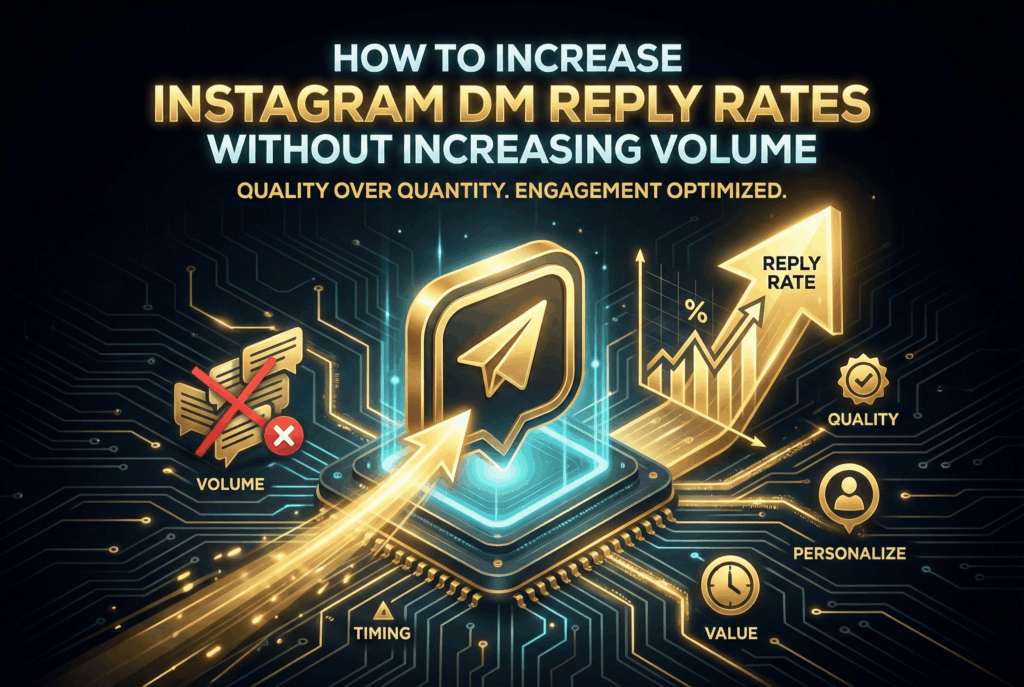
For many agencies, the instinctive response to low performance in direct messaging is simple: send more messages. Increase outreach. Expand targeting. Push harder.
Yet in modern Instagram DM automation environments, volume rarely solves performance issues. In fact, increasing outbound volume often decreases overall effectiveness. Reply rates drop. Deliverability weakens. Message limits tighten. Accounts accumulate subtle friction signals that compound over time.
The real lever for sustainable growth is not quantity. It is conversation quality and behavioral alignment.
Increasing Instagram DM reply rates without increasing volume requires reengineering how outreach is structured, timed, and escalated. It demands a shift from transactional messaging to trust-based conversation architecture.
Optimize for Relevance, Not Reach
When agencies try to improve Instagram DM reply rates, their first instinct is often expansion. Broader targeting. Larger prospect pools. Higher outbound activity. Yet low response performance is rarely caused by insufficient reach. It is almost always caused by insufficient relevance.
Relevance is the hidden multiplier in Instagram DM outreach performance.
A message that feels personally contextualized generates exponentially higher response probability than a message sent to a perfectly segmented but emotionally disconnected audience. Even the most advanced targeting frameworks fail if the first line ignores the recipient’s visible signals.
Relevance begins with observation.
Before initiating a DM, high-performing systems evaluate engagement history, profile themes, recent content activity, and behavioral cues. Has the user interacted with a story recently? Have they posted about a topic aligned with the brand? Is there visible common ground? These signals transform outreach from interruption into continuation.
This matters both psychologically and algorithmically.
Psychologically, recipients respond when they feel recognized rather than targeted. Generic openers trigger skepticism. Contextual openers trigger curiosity. When a message reflects actual awareness—without over-personalization—it lowers resistance dramatically.
Algorithmically, relevance improves conversation depth. Instagram evaluates messaging not only by outbound count but by engagement outcome. Messages that consistently produce shallow exchanges or no replies contribute to weaker trust signals. Messages that generate sustained interaction reinforce positive behavioral scoring.
In scalable Instagram automation architecture, relevance must be engineered structurally.
This means filtering targets based on engagement signals rather than demographic assumptions alone. It means delaying outreach until behavioral indicators suggest openness. It means prioritizing smaller, higher-probability cohorts over mass distribution.
Volume without relevance dilutes reply rates. Relevance without excessive volume compounds them.
Another overlooked dimension of relevance is conversational framing. The first message should not feel like a template with variables inserted. It should align with the user’s visible context naturally. Referencing a recent story, acknowledging shared interest, or commenting lightly on a content theme creates conversational entry grounded in reality.
However, relevance must remain subtle.
Overly detailed personalization can feel performative or invasive. The objective is alignment, not analysis. A single authentic contextual anchor often outperforms heavy customization.
Relevance also reduces cross-account similarity risk in multi-account Instagram DM automation systems. When each message adapts to unique user context, linguistic overlap decreases. Pattern density drops. Automation becomes statistically dispersed rather than clustered.
From a performance perspective, relevance improves efficiency per message. Higher reply rates reduce the need for increased outbound volume. Lower volume decreases restriction risk. Improved conversation depth strengthens deliverability over time.
This creates a compounding effect.
Agencies that optimize for reach often sacrifice depth. Agencies that optimize for relevance increase both reply rates and long-term account stability simultaneously.
Ultimately, improving Instagram DM reply rates without increasing volume is not about sending more messages. It is about sending fewer messages that feel more justified.
Relevance transforms outreach from broadcast into dialogue.
And dialogue is what the platform is built to reward.
Shorten the Opening, Lengthen the Conversation
One of the most underestimated reasons for low Instagram DM reply rates is message density in the very first interaction. Agencies often attempt to maximize efficiency by front-loading value, intent, credibility, and positioning into the opening message. The result is predictable: cognitive overload and declining response probability.
The first DM is not the place to explain everything.
When the opening message is too long, too detailed, or too outcome-oriented, it creates pressure. Recipients subconsciously perceive commitment before connection. Instead of feeling invited into dialogue, they feel pulled into a process. On Instagram—a platform designed around light, rapid interaction—this friction significantly reduces reply likelihood.
Short openings reduce psychological resistance.
A concise, context-aware message lowers the barrier to entry. It feels casual. It requires minimal effort to answer. The recipient does not need to evaluate a proposal, process an offer, or respond thoughtfully to multiple points. They simply need to reply.
This shift is critical in Instagram DM automation strategies where scale amplifies every inefficiency. If the first message reduces reply probability by even a small percentage, that drop compounds across dozens or hundreds of conversations.
But shortening the opening does not mean weakening the strategy. It means redistributing structure.
Instead of compressing intent into the first message, high-performing systems stretch progression across multiple exchanges. The first message invites. The second builds rapport. The third deepens alignment. Only after conversational momentum is established does escalation become appropriate.
Instagram’s behavioral models reward sustained interaction. Accounts that generate longer back-and-forth threads accumulate stronger conversational trust signals. Shallow exchanges—where the first message contains everything and the second never arrives—create negative engagement density.
Lengthening the conversation improves not only reply rates but also deliverability stability.
When recipients respond, the conversation thread gains algorithmic weight. Message filtering risk decreases. Future outreach experiences less friction. Over time, accounts known for generating meaningful dialogue operate within healthier engagement baselines.
Another crucial element is pacing elasticity.
A short opening creates flexibility. If the recipient responds enthusiastically, the conversation can expand naturally. If the response is brief, the tone can remain light. Overly detailed first messages remove this adaptability. They lock the conversation into a predetermined path.
In scalable multi-account Instagram outreach systems, structured elasticity reduces cross-account similarity as well. Long scripted openers tend to resemble each other. Short, context-driven invitations vary naturally because they are anchored in recipient-specific signals.
The objective is not to persuade in the first message. It is to create momentum.
Momentum builds through reciprocity. Each reply justifies the next message. Each exchange increases engagement depth. Each incremental layer strengthens trust—both with the recipient and within Instagram’s conversational scoring models.
Agencies that attempt to convert immediately often sacrifice response probability. Agencies that prioritize entry over persuasion increase total conversation volume organically without increasing outbound volume.
Shorten the opening. Lengthen the dialogue.
In the modern Instagram DM performance framework, conversation depth scales further than message density.

Adjust Timing Based on Behavioral Signals
Timing is one of the most underleveraged levers in improving Instagram DM reply rates. Most outreach systems rely on fixed schedules. Messages are sent at predefined hours. Follow-ups are triggered after static intervals. Escalation occurs according to rigid time gaps.
This approach optimizes convenience, not responsiveness.
In reality, reply probability is heavily influenced by behavioral timing alignment. When a message reaches a recipient during an active engagement window, the likelihood of response increases significantly. When it lands during inactivity, it sinks into inbox noise.
Improving reply rates without increasing volume requires abandoning static timing in favor of signal-based timing.
Behavioral signals include recent story interactions, profile activity spikes, content uploads, engagement bursts, and response recency. If a user has interacted with content within the last few hours, their attentional state is already oriented toward the platform. Messaging during this window feels natural and timely.
This alignment matters not only psychologically, but algorithmically.
Instagram evaluates conversation vitality. Messages that trigger rapid back-and-forth exchanges generate stronger engagement signals. Threads that sit dormant immediately after initiation weaken perceived conversational value. Over time, repeated shallow threads can contribute to lower DM deliverability and outreach performance.
Adjusting timing based on behavioral signals increases the probability of early replies, which strengthens conversational momentum from the first exchange.
Follow-up timing is equally critical.
Uniform follow-up intervals—such as always sending a reminder after 24 hours—create mechanical patterns. Across multiple accounts, these synchronized follow-ups amplify behavioral correlation risk. They also reduce effectiveness because they ignore user-specific pacing.
Signal-based follow-ups consider response tempo. If a user typically replies within minutes, extended silence may indicate disinterest. If a user replies once daily, patience is appropriate. Adaptive pacing respects individual rhythm.
This elasticity increases reply rates because it reduces perceived pressure.
Timing adjustments also support account safety.
When messaging velocity adapts to behavioral signals, outbound activity naturally disperses. Activity spikes become less synchronized across accounts. Clustering density decreases. Instead of sending DMs in concentrated bursts, systems distribute conversations more organically across the day.
In scalable Instagram automation architecture, signal-based timing introduces controlled unpredictability. Not randomness, but dispersion. Each account operates on slightly different engagement windows. Each conversation evolves on its own tempo.
Another important factor is micro-momentum.
When a recipient responds, rapid acknowledgment reinforces engagement. Delayed responses from the sender can stall conversational energy. However, overly instantaneous replies across all accounts can appear automated. Balanced responsiveness—variable yet attentive—mirrors real human interaction patterns.
Optimizing timing therefore requires dual calibration: responsive without being mechanical, proactive without being intrusive.
Agencies that increase volume to compensate for low reply rates often mask a timing inefficiency problem. By aligning outreach with observable behavioral signals, reply rates improve without expanding outbound activity.
Higher reply density strengthens platform trust. Stronger trust improves deliverability. Improved deliverability further increases reply probability.
This creates a performance loop powered by timing intelligence rather than message volume.
In modern Instagram DM outreach systems, when you send the message often matters more than what the message says.
Improve Conversational Momentum, Not Message Count
When reply rates begin to decline, many agencies react by increasing outbound activity. More DMs. More prospects. More daily volume. Yet in modern Instagram DM automation systems, message count is rarely the root problem. The true issue is usually a lack of conversational momentum.
Momentum is what keeps a dialogue alive after the first response.
A single reply does not equal engagement. It is the beginning of an exchange that either gains energy or collapses immediately. If the second message fails to deepen interaction, conversations stall. Stalled threads reduce overall Instagram DM reply rates because the account begins accumulating shallow exchanges rather than sustained dialogue.
Instagram’s behavioral models reward depth, not density.
Accounts that consistently generate back-and-forth conversations signal relational intent rather than transactional outreach. Threads with multiple reciprocal replies strengthen conversational trust signals. Threads that end after one or two mechanical exchanges contribute to weak engagement clustering.
Improving conversational momentum therefore requires optimizing how replies are handled—not how many first messages are sent.
Momentum increases when responses feel attentive and adaptive.
Generic acknowledgments such as “Nice” or “That’s great” halt progression. They provide no new conversational direction. High-performing systems respond with curiosity. They expand slightly on the user’s input. They introduce light, relevant follow-ups that invite continuation without pressure.
This is where many Instagram outreach strategies break down. Automation often focuses on the opener and the closing call to action, but neglects the middle. Yet the middle is where trust accumulates.
Conversational momentum is built through reciprocity.
When a user shares a detail, it should be acknowledged meaningfully. When a user asks a question, the response should feel proportional. When energy increases, pacing can accelerate. When energy decreases, tone should soften. This dynamic responsiveness mirrors real human interaction patterns.
Momentum also depends on escalation restraint.
Premature intent disrupts flow. Introducing offers or links too early often collapses dialogue. Gradual, depth-based escalation preserves energy. When intent emerges organically from interaction, conversation continues rather than terminates.
From a safety perspective, stronger conversational momentum improves account stability. Threads with depth generate positive interaction signals. Higher-quality exchanges improve overall DM deliverability and reduce the likelihood of message filtering.
From a performance perspective, deeper conversations increase conversion probability without requiring higher outreach volume. One sustained thread often outperforms five shallow attempts.
Another overlooked factor is conversational variability.
Not every exchange should follow the same arc. Some conversations may remain light and relational. Others may become strategic and goal-oriented. This variability reduces cross-account similarity in multi-account Instagram automation environments, lowering correlation risk while increasing authenticity.
Agencies that focus on message count often create mechanical systems that generate surface-level replies but fail to maintain engagement. Agencies that focus on conversational momentum build ecosystems where replies multiply naturally.
The objective is not to send more messages. It is to create exchanges worth continuing.
In scalable Instagram DM performance architecture, momentum compounds. Every meaningful reply strengthens the next. Every sustained thread improves account trust. Over time, reply rates increase not because volume expanded, but because conversations became worth having.
Quality momentum scales further than message quantity.
Increasing Instagram DM reply rates without increasing volume is not about crafting better scripts. It is about engineering better conversations.
Relevance improves response probability. Concise openings reduce friction. Behavioral timing increases visibility. Depth-based escalation strengthens trust. Together, these adjustments transform outreach efficiency without expanding outbound activity.
In modern Instagram automation architecture, volume amplifies risk when quality is weak. When quality is strong, volume becomes secondary.
Agencies that prioritize conversational alignment over message quantity achieve higher reply rates, stronger deliverability, and more stable long-term performance.
The most scalable Instagram outreach systems are not the loudest.
They are the most contextually intelligent.
Don't stop at reading.
Join the community or pick a plan and start automating today.
Get help, share wins, stay ahead.
Thousands of operators, direct support from the team, and a live feed of updates, tips and drops.
- Live support and troubleshooting from the team and power users
- Setup walkthroughs, targeting tips and workflow templates
- Early word on new bots, features and releases
Ready to put growth on autopilot?
Run your accounts, clients or traffic funnel while Onimator does the work. Start scaling today.
- Unlimited accounts
- All available tasks
- Integrated AI Chatter
- Up to 7 devices