
Behavioral Archetypes in Instagram Automation: How to Diversify 100+ Accounts Without Losing Brand Control
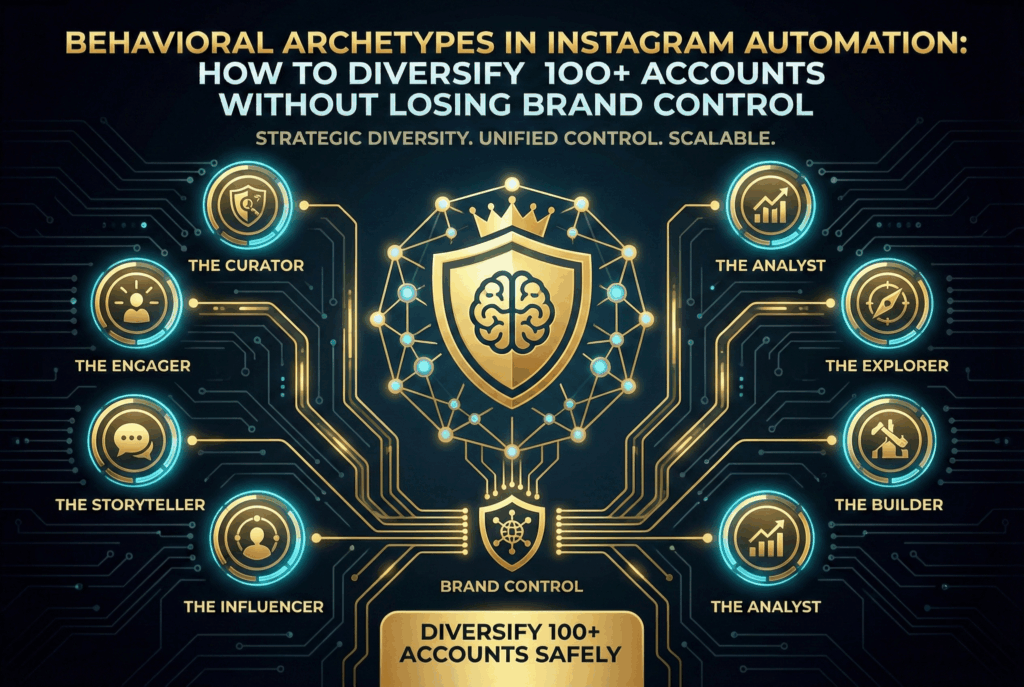
Scaling beyond ten Instagram accounts is operational. Scaling beyond one hundred becomes architectural.
At that level, traditional automation frameworks begin to collapse under their own uniformity. Identical messaging flows, synchronized outreach windows, mirrored escalation logic, and centralized playbooks create measurable behavioral correlation density. The more accounts behave alike, the more detectable the system becomes.
Yet dispersion alone is not the solution.
If diversification is unmanaged, brand voice fragments. Tone becomes inconsistent. Conversion pathways weaken. Strategic coherence dissolves.
This is where behavioral archetypes in Instagram automation become essential. Archetypes allow agencies to engineer structured diversity—preserving brand control while reducing cross-account similarity.
Why Uniform Automation Fails at Scale
Uniform automation feels logical when agencies begin scaling. It simplifies training, standardizes workflows, and makes performance easier to measure. A single outreach funnel, one escalation structure, one follow-up timing model, and one centralized playbook create clarity across teams. At small scale, this structure often performs well because behavioral similarity density remains low and clustering risk is minimal.
The problem begins when scale increases.
When ten accounts follow the same progression logic, the statistical footprint is relatively small. When one hundred accounts mirror identical behavioral arcs, escalation depth, and timing patterns, structural repetition becomes measurable. Instagram’s detection systems do not evaluate accounts purely in isolation; they analyze cross-account behavioral similarity across multiple dimensions. As the number of synchronized accounts grows, correlation confidence increases proportionally.
Uniform Instagram automation amplifies pattern density because it replicates structure, not just messaging.
Even if agencies rotate wording or introduce minor phrasing variations, the underlying conversation progression architecture frequently remains identical. Conversations may consistently escalate after the same number of exchanges. Follow-ups may trigger at nearly identical intervals. Activity windows may cluster within predictable daily blocks. From an internal operational perspective, this feels organized and controlled. From an external analytical perspective, it produces structural symmetry that detection systems are designed to recognize.
At scale, symmetry becomes signal.
Another compounding factor is synchronized optimization. When agencies manage performance centrally, strategic adjustments are often implemented across all accounts simultaneously. If Instagram DM reply rates decline, escalation pacing is shortened across the network. If engagement drops, outreach windows expand everywhere at once. These synchronized shifts create visible behavioral waves. Even corrective measures, when deployed uniformly, can increase behavioral clustering sensitivity.
Uniform systems also compress timing variability. Accounts tend to operate within the same activity windows, respond within similar time ranges, and escalate within comparable conversational depth thresholds. Real user ecosystems rarely display this level of alignment. Organic behavior fluctuates across individuals; some users are highly active in the morning, others late at night. Some escalate conversations quickly, others slowly. Uniform automation architecture removes this natural dispersion.
The impact of similarity grows nonlinearly as scale increases. Minor structural overlap across a handful of accounts may go unnoticed. The same overlap across a large network compounds into measurable density. This is why systems that function safely at moderate scale often begin experiencing friction once the account base expands significantly.
It is important to clarify that Instagram automation itself is not the issue. The vulnerability emerges from replication without dispersion. When identical behavioral frameworks are applied across dozens or hundreds of accounts, repetition accumulates. Over time, this accumulation influences Instagram DM deliverability, message filtering, and overall account stability.
Agencies sometimes attempt to solve this by introducing random behavior. However, randomness without architectural boundaries undermines brand cohesion and performance consistency. What is required instead is structured diversification—systems that preserve strategic alignment while distributing behavioral expression across accounts.
Uniform automation offers operational simplicity, but at scale, simplicity can translate into exposure. Sustainable growth requires engineered behavioral dispersion across timing, escalation pacing, conversational rhythm, and account-level identity.
At higher levels of scale, the objective is no longer just performance optimization.
It is similarity management in multi-account Instagram automation systems.
Defining Behavioral Archetypes Within Brand Boundaries
The concept of behavioral archetypes in Instagram automation is often misunderstood. Many agencies assume that diversification requires changing tone, messaging style, or even core positioning. In reality, archetypes are not about altering the brand — they are about varying behavioral expression while preserving strategic identity.
A brand has one voice. But it does not need one rhythm.
Brand voice defines values, positioning, emotional range, and communication standards. It answers the question of what the brand stands for and how it speaks at a strategic level. Behavioral archetypes, on the other hand, define how that voice moves — how quickly conversations escalate, how frequently questions are asked, how engagement is paced, and how interaction depth evolves over time.
This distinction is critical in multi-account Instagram automation systems.
Without archetypes, agencies replicate a single behavioral template across dozens or hundreds of accounts. Even if copy varies slightly, escalation timing, conversational structure, and response pacing remain identical. Over time, this produces measurable behavioral correlation density. Archetypes interrupt that symmetry without fragmenting brand coherence.
A properly designed Instagram automation archetype framework operates within fixed boundaries. Core messaging pillars remain consistent. Offer positioning does not change. Brand tone limits are clearly defined. What changes is the structural delivery.
One archetype may operate with a relationship-first rhythm, prioritizing extended rapport and slower escalation. Another may maintain a concise and direct conversational flow, still aligned with brand tone but structurally different in pacing. A third archetype may rely more heavily on question-driven dialogue, while a fourth may use statement-led engagement that encourages natural reciprocation.
All remain within the same brand identity.
The purpose of archetypes is not aesthetic variation. It is structural dispersion.
When escalation thresholds vary across archetypes, cross-account similarity decreases. When response timing elasticity differs slightly between archetypes, synchronized rhythm weakens. When conversational depth patterns are not uniform across the network, clustering confidence drops.
At scale, this dispersion becomes essential.
Defining archetypes requires identifying the behavioral dimensions that most influence detection and performance. These typically include escalation pacing, follow-up intervals, conversational length preference, emotional modulation range, and interaction intensity curves. By varying these dimensions within approved brand parameters, agencies create distributed individuality.
AI-powered systems are particularly effective in implementing archetypes because prompt layers can be segmented by account clusters. Instead of one global instruction set, multiple behavioral frameworks guide conversation flow. This allows for controlled differentiation without sacrificing compliance with brand guidelines.
Human oversight remains crucial.
Archetypes must be monitored to ensure they do not drift beyond tone boundaries. Centralized analytics should track Instagram DM deliverability, conversation depth, and reply rates across archetype clusters. If one archetype underperforms or begins producing structural compression, adjustments can be applied selectively rather than globally.
This selective optimization prevents synchronized pattern shifts across the entire ecosystem.
When implemented correctly, behavioral archetypes do more than reduce detection risk. They increase authenticity. Real communities are not composed of identical personalities speaking in identical cadence. A brand represented through varied yet aligned behavioral expressions feels more organic and credible.
Ultimately, defining archetypes within brand boundaries is about separating identity from execution.
The brand remains singular.
The behavior becomes distributed.
In scalable Instagram automation architecture, this distinction is what allows agencies to diversify 100+ accounts without losing control — and without creating the uniformity that makes large systems fragile.

Engineering Diversification Across 100+ Accounts
Scaling to one hundred or more profiles requires more than tactical variation. It requires architectural design. At this level, diversification cannot rely on improvisation or manual nuance. It must be engineered systematically into the foundation of the multi-account Instagram automation system.
Diversification is not randomness. It is controlled dispersion.
When agencies attempt to diversify behavior informally, they often introduce inconsistency rather than structural independence. Messaging tone drifts. Escalation becomes unpredictable. Brand coherence weakens. Meanwhile, hidden structural similarities remain intact because the underlying automation framework has not changed.
True behavioral diversification at scale begins with segmentation.
Accounts should be grouped into distinct behavioral archetype clusters, each operating under slightly different progression logic. Escalation thresholds must vary. Some clusters may introduce intent only after extended engagement depth. Others may escalate earlier but maintain slower follow-up pacing. This layered differentiation reduces cross-account similarity density without altering brand positioning.
Timing dispersion is equally critical.
If all accounts operate within similar outreach windows, synchronized activity bursts create temporal clustering. Engineering diversification means distributing engagement cycles across broader time ranges. Follow-up intervals must adapt dynamically rather than rely on fixed timers. Message response elasticity should vary naturally between account clusters.
Linguistic structure also requires architectural variation.
Diversification should extend beyond vocabulary changes. Sentence cadence, emotional modulation patterns, question frequency, and call-to-action framing should differ subtly across clusters. For example, one archetype may rely more heavily on open-ended questions, while another favors conversational affirmations before transitioning into next steps. Both align with brand tone, yet they produce different conversational rhythms.
AI systems play a powerful role here when implemented correctly.
Instead of deploying one global prompt architecture, agencies should implement segmented instruction layers tied to behavioral archetypes. Each cluster operates within predefined boundaries but follows differentiated pacing rules and conversational progression structures. This prevents replication from propagating across the entire network.
Infrastructure segmentation must support behavioral diversification.
If diversified messaging flows still occur within identical session windows and technical environments, dispersion weakens. Staggered onboarding, distributed operational blocks, and differentiated activity cycles reinforce behavioral separation at the structural level.
Monitoring becomes more nuanced at this scale.
Centralized analytics should track performance not only at the account level but at the archetype cluster level. Metrics such as Instagram DM deliverability, reply rate elasticity, conversation depth, and escalation conversion timing must be evaluated comparatively. If one cluster begins to exhibit structural compression, adjustments can be applied selectively.
Selective recalibration prevents synchronized behavioral shifts across all 100+ accounts.
Another critical dimension is adaptive scaling.
As the network grows, diversification intensity must increase proportionally. Similarity that is negligible at 20 accounts may become significant at 120. Engineering dispersion is not a one-time configuration; it is an evolving process aligned with network expansion.
The goal of engineering diversification across 100+ Instagram accounts is not to make each profile radically different. It is to ensure that no measurable structural pattern repeats excessively across the ecosystem.
Strategic identity remains centralized. Behavioral execution becomes distributed.
When diversification is architected rather than improvised, automation transitions from replication to ecosystem modeling. Accounts no longer move in parallel. They operate as differentiated yet aligned participants within a coordinated framework.
At this level of scale, performance optimization alone is insufficient.
Similarity management becomes a core competency.
And diversification, when engineered deliberately, becomes the foundation of long-term stability.
Maintaining Brand Control While Increasing Behavioral Independence
The greatest hesitation agencies face when implementing behavioral archetypes in Instagram automation is the fear of losing brand cohesion. Diversification sounds risky. If accounts begin operating independently, does the brand voice fragment? Does messaging drift? Does performance become unpredictable?
The answer depends entirely on architecture.
Behavioral independence does not mean abandoning control. It means separating strategic identity from execution rhythm. Brand control exists at the level of positioning, value proposition, emotional range, and communication boundaries. Behavioral independence exists at the level of pacing, escalation structure, interaction density, and conversational flow.
When these layers are clearly distinguished, diversification strengthens rather than weakens the brand.
Maintaining brand control in multi-account Instagram automation requires centralized governance with decentralized expression. Core messaging pillars must remain fixed. Offer framing must stay aligned. Tone boundaries should be clearly documented and enforced across all archetypes. What varies is how and when those elements are introduced within conversations.
For example, every account may represent the same brand promise. However, one behavioral archetype may introduce that promise gradually through extended rapport, while another integrates it earlier within dialogue. Both remain strategically aligned, yet structurally differentiated.
This layered approach prevents cross-account similarity without compromising brand consistency.
AI systems can reinforce this balance effectively. Instead of deploying a single global prompt, agencies can create archetype-specific instruction sets that operate within shared brand constraints. The brand voice parameters remain constant, while pacing rules and escalation triggers vary subtly across clusters.
Human oversight plays a stabilizing role in this model.
Centralized monitoring ensures that no archetype drifts beyond approved communication boundaries. Performance analytics track not only reply rates and conversion metrics but also tone adherence and structural consistency within each cluster. If variation begins to compromise brand clarity, corrective adjustments can be applied selectively rather than globally.
Selective optimization prevents synchronized structural shifts across the entire network.
Another important dimension of maintaining brand control is documentation.
Clear behavioral guidelines should define what cannot change. These may include prohibited escalation styles, unacceptable tone shifts, or mandatory positioning statements. Within those boundaries, archetypes can operate with flexibility.
This framework creates controlled freedom.
Instead of one rigid automation system replicated across 100 accounts, agencies manage a diversified ecosystem governed by centralized principles. The brand speaks consistently at a strategic level while expressing itself differently at the behavioral level.
Importantly, this model often enhances authenticity.
Real organizations are not represented by a single personality in every interaction. Different team members naturally communicate with subtle variation while upholding shared values. Behavioral independence mirrors this organic diversity, making automation systems appear more human and less mechanically synchronized.
At scale, maintaining brand control becomes less about restricting variation and more about defining boundaries clearly.
When boundaries are strong, dispersion is safe.
In advanced Instagram automation architecture, the objective is not to create identical replicas of one voice. It is to create a coordinated network of differentiated expressions operating under one strategic identity.
Brand coherence provides stability.
Behavioral independence provides resilience.
The agencies that master both are able to scale 100+ accounts without sacrificing either performance or protection.
Managing 100+ Instagram accounts safely requires more than volume control. It requires pattern dispersion without strategic fragmentation.
Behavioral archetypes in Instagram automation provide that balance.
They reduce cross-account similarity. They weaken clustering confidence. They introduce controlled variability in escalation logic, timing rhythm, and conversational flow. At the same time, they preserve brand identity through centralized governance.
Uniform automation is efficient but fragile.
Random diversification is unpredictable and unstable.
Structured archetypes create resilience.
In scalable multi-account Instagram automation architecture, the goal is not to make every account sound different.
It is to make every account behave independently while speaking the same brand language.
Diversity protects scale.
Structure preserves control.
The agencies that master both build automation systems that grow without becoming visible.
Don't stop at reading.
Join the community or pick a plan and start automating today.
Get help, share wins, stay ahead.
Thousands of operators, direct support from the team, and a live feed of updates, tips and drops.
- Live support and troubleshooting from the team and power users
- Setup walkthroughs, targeting tips and workflow templates
- Early word on new bots, features and releases
Ready to put growth on autopilot?
Run your accounts, clients or traffic funnel while Onimator does the work. Start scaling today.
- Unlimited accounts
- All available tasks
- Integrated AI Chatter
- Up to 7 devices