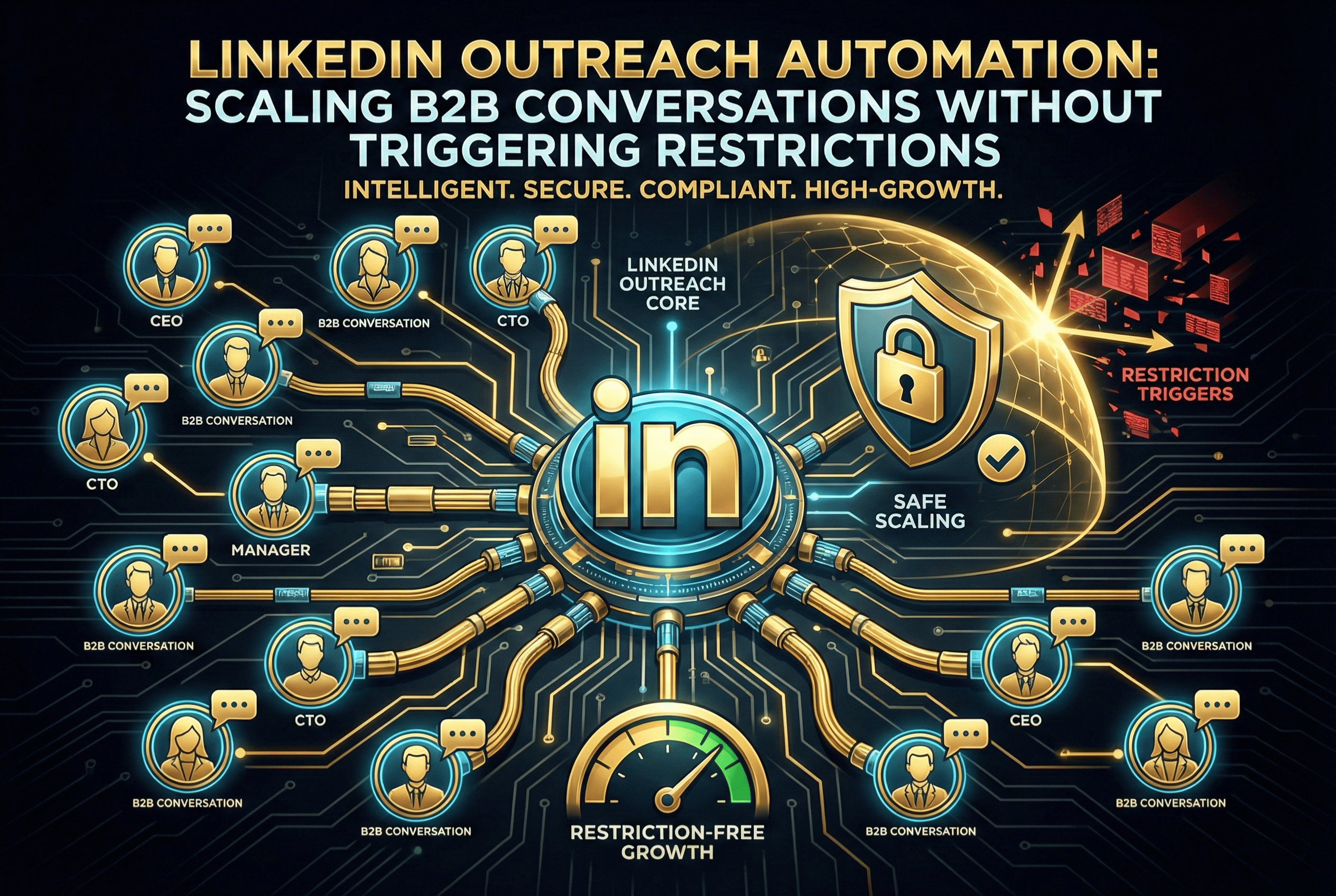
Scaling outbound on LinkedIn is fundamentally different from scaling on most social platforms. While Instagram and TikTok prioritize content distribution, LinkedIn is built around direct professional interaction. That makes LinkedIn outreach automation both powerful and highly sensitive.
Many agencies attempt to scale B2B conversations by increasing connection requests, automating follow-ups, and standardizing messaging flows. In the short term, results may improve. In the long term, however, poorly structured systems often lead to LinkedIn restrictions, connection limits, or reduced message visibility.
The core challenge is not volume alone.
It is how volume interacts with behavioral credibility.
Understanding how to scale LinkedIn automation for B2B outreach safely requires a shift from action-based thinking to pattern-based architecture.
Why LinkedIn Restricts Automated Outreach
Understanding why LinkedIn restricts automated outreach requires recognizing how fundamentally different LinkedIn is from entertainment-driven social platforms. LinkedIn is built around professional credibility, trust-based networking, and high-intent communication. As a result, its detection systems are designed not only to prevent spam, but to preserve the integrity of business relationships on the platform.
Most restrictions do not occur simply because automation is used. They occur when behavioral patterns signal low relevance, aggressive scaling, or structural repetition.
One of the primary triggers is abnormal connection velocity. LinkedIn continuously evaluates how many connection requests an account sends relative to its historical baseline and acceptance rate. When accounts suddenly increase invitation volume without a proportional increase in acceptance, the system interprets this as reduced targeting quality. Over time, low acceptance ratios combined with high outreach volume significantly increase LinkedIn automation risk.
Another major factor is structural similarity in messaging.
If an account consistently follows the same progression model—connection request, thank-you message, qualifying question, and rapid offer introduction—the system begins to detect repetitive behavioral architecture. Even when message wording varies, identical escalation timing across hundreds of conversations creates conversation progression symmetry, which is statistically measurable.
LinkedIn’s systems are particularly sensitive to messaging compression. When escalation happens too quickly, especially before meaningful dialogue is established, it increases the likelihood that recipients ignore, mute, or report the interaction. These negative engagement signals directly influence LinkedIn account trust scoring.
Timing patterns also contribute to restriction probability.
If connection requests or follow-up messages are sent in tightly clustered time blocks each day, the system may interpret this as automated orchestration rather than organic professional networking. Real users tend to distribute activity irregularly based on work schedules, meetings, and daily fluctuations. Uniform operational windows reduce natural variability and increase detectable alignment.
Sudden behavioral shifts further amplify risk.
Accounts that transition from low activity to aggressive outbound scaling create anomaly signals. LinkedIn evaluates trajectory over time, meaning abrupt changes in volume or messaging intensity are often flagged as unusual. Gradual scaling aligned with consistent engagement performance is far less likely to trigger protective measures.
Infrastructure stability also plays a role. Frequent login inconsistencies, rapid environment switching, or scaling across multiple accounts using synchronized operational rhythms can reinforce automation detection models. While LinkedIn does not publicly disclose full technical evaluation layers, behavioral consistency combined with environmental anomalies increases overall restriction probability.
Importantly, LinkedIn does not need to detect identical templates to restrict outreach. It evaluates probability. When multiple signals—low acceptance rates, compressed escalation, synchronized timing, and structural repetition—converge, the system reduces invitation capacity or temporarily limits messaging ability.
The purpose of these restrictions is not punitive. It is protective.
LinkedIn prioritizes user experience and relevance. Accounts that demonstrate contextual targeting, gradual scaling, and adaptive pacing accumulate stronger trust signals. Accounts that prioritize aggressive volume over engagement quality gradually lose distribution privileges.
Understanding why LinkedIn restricts automated outreach shifts the focus from action limits to behavioral credibility. Safe scaling requires proportional growth, distributed timing patterns, diversified conversation architecture, and continuous monitoring of acceptance performance.
In advanced LinkedIn outreach automation systems, sustainability is achieved not by maximizing daily quotas, but by preserving measurable trust signals across every interaction.
Designing Natural Connection Velocity
A sustainable LinkedIn outreach automation strategy begins with one core principle: connection velocity must feel organic. LinkedIn continuously evaluates how accounts grow their networks, not only by measuring the number of invitations sent, but by analyzing the relationship between invitation volume, acceptance rate, and historical behavior patterns.
Designing natural connection velocity on LinkedIn means aligning outreach intensity with engagement performance and account maturity. Newer accounts that suddenly send dozens of invitations per day often trigger anomaly signals because their behavioral trajectory does not match their historical baseline. In contrast, accounts that increase volume gradually, in proportion to their network size and acceptance ratio, appear more credible within LinkedIn’s trust modeling framework.
Acceptance rate is one of the most important variables in this equation.
If an account consistently sends a high number of connection requests but receives a low percentage of acceptances, LinkedIn interprets this as reduced targeting precision. Over time, this weakens LinkedIn account trust scoring and may result in reduced invitation capacity. Safe automation systems therefore adjust connection volume dynamically based on performance data rather than operating at fixed daily quotas.
Timing elasticity is equally critical.
Sending invitations in tightly compressed operational blocks—such as the same hour every weekday—creates detectable rhythm consistency. Real professionals do not typically connect with dozens of new contacts within identical time windows every day. Distributing invitations across broader time ranges introduces natural variability and reduces temporal compression signals.
Another key aspect of safe LinkedIn scaling is pacing growth relative to account age and activity history. Accounts that gradually expand outreach over weeks and months accumulate credibility signals. Abrupt scaling spikes, especially after periods of inactivity, increase the probability of protective restrictions because they deviate from expected behavioral patterns.
Designing natural velocity also involves balancing outbound activity with inbound and organic engagement. Accounts that only send invitations and messages without engaging in feed activity, commenting on posts, or publishing content appear transactional. In contrast, profiles that combine outreach with visible participation in the LinkedIn ecosystem reinforce authenticity and reduce automation perception.
Adaptive systems outperform static ones.
Instead of setting a fixed number of daily invitations, advanced LinkedIn automation architecture incorporates acceptance rate thresholds, response latency trends, and engagement depth metrics into pacing logic. When acceptance declines, invitation volume decreases automatically. When engagement quality improves, scaling occurs gradually rather than instantly.
The goal is not to maximize invitations.
It is to maintain sustainable growth that aligns with LinkedIn’s behavioral expectations.
In large-scale B2B outreach environments, the difference between aggressive scaling and natural velocity often determines long-term account stability. By engineering gradual expansion, distributed timing patterns, and performance-responsive pacing, agencies can scale network growth without triggering LinkedIn outreach restrictions.
Natural connection velocity is not about sending fewer requests.
It is about sending them in a way that aligns with professional behavioral norms and measurable trust signals.
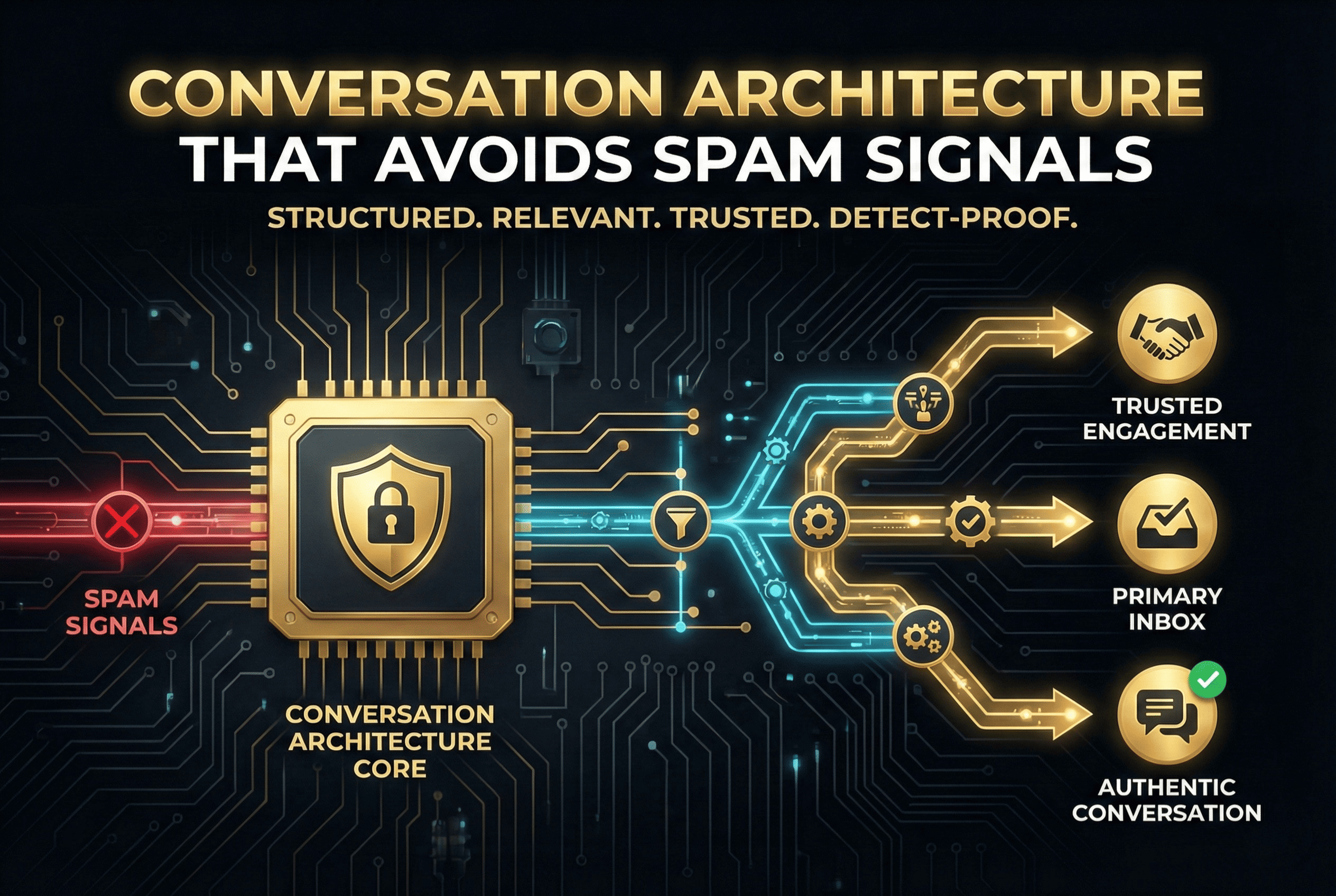
Conversation Architecture That Avoids Spam Signals
One of the most common reasons LinkedIn outreach automation leads to restrictions is not message volume itself, but predictable conversation structure. LinkedIn’s detection systems evaluate how interactions unfold over time, analyzing escalation timing, repetition patterns, and engagement depth rather than simply scanning for identical templates. When messaging follows rigid, compressed funnels across dozens or hundreds of conversations, structural similarity becomes measurable.
Designing a conversation architecture that avoids spam signals requires moving away from fixed-sequence outreach models. Many automated systems rely on identical progression logic: connection request, thank-you message, qualifying question, value proposition, calendar link. Even when wording changes slightly, the escalation depth remains consistent. When this pattern repeats at scale, conversation progression symmetry increases, raising detection probability.
LinkedIn’s ecosystem rewards relational pacing.
If escalation toward an offer occurs too early in the interaction, recipients are more likely to disengage or ignore the message. High ignore rates, low reply depth, and minimal back-and-forth exchanges contribute to reduced LinkedIn account trust scoring. Over time, these engagement signals affect message visibility and invitation capacity.
Safe LinkedIn message automation introduces variability into progression timing. Some conversations should remain purely relational, focused on shared interests or professional dialogue. Others may transition into business discussions only after meaningful reciprocity is established. Escalation should depend on engagement signals such as response length, tone, and follow-up questions rather than fixed exchange counts.
Message cadence also plays a critical role.
Uniform response intervals and identical follow-up spacing create detectable rhythm consistency. Introducing controlled timing elasticity reduces pattern compression and aligns interaction flow with organic professional behavior. Professionals naturally respond based on availability, context, and interest, not pre-programmed intervals.
Language structure must vary at the architectural level.
Avoiding spam signals requires more than swapping synonyms. Sentence length distribution, emotional modulation, and question frequency should differ subtly across conversations. If every message contains a soft curiosity pivot or similar call-to-action framing, structural similarity compounds. Linguistic fingerprint density increases even when surface phrasing appears unique.
Contextualization is equally important in reducing LinkedIn spam detection risk.
Referencing recent posts, shared industry topics, or mutual connections adds relevance signals that differentiate messages from generic outreach. Context-driven dialogue reinforces credibility and reduces the likelihood of being perceived as automated.
High-performing systems balance performance optimization with dispersion management.
While it may be tempting to standardize a single high-converting outreach script across all accounts, doing so increases cross-conversation similarity at scale. Sustainable architecture distributes escalation logic across differentiated conversation models, maintaining strategic alignment while preventing uniformity.
Ultimately, avoiding spam signals on LinkedIn is not about minimizing outreach. It is about designing conversational systems that mirror real professional interaction patterns. Gradual escalation, variable pacing, contextual engagement, and diversified structural frameworks allow automation to scale without triggering defensive restrictions.
In advanced LinkedIn automation systems, conversation architecture is not simply a messaging tool. It is a trust management mechanism that determines whether scaling efforts remain sustainable or become visibly automated over time.
Conversation Architecture That Avoids Spam Signals
When scaling LinkedIn outreach automation, the structure of the conversation matters just as much as the content of the message. LinkedIn’s systems are designed to protect professional users from irrelevant or aggressive solicitation, which means they evaluate how interactions unfold over time. A rigid, highly predictable outreach funnel may convert in the short term, but at scale it increases the probability of triggering LinkedIn spam signals.
The most common mistake in automated outreach is using a fixed progression blueprint. Many systems rely on a sequence such as connection request, immediate thank-you message, qualifying question, offer introduction, and calendar link. Even if the wording is slightly modified across prospects, the conversation progression structure remains identical. When this same escalation pattern is repeated across dozens or hundreds of conversations, structural symmetry becomes measurable.
LinkedIn does not need identical templates to detect automation.
Instead, it analyzes behavioral consistency, escalation timing, reply depth, and engagement outcomes. If offers consistently appear after the same number of exchanges, or if follow-ups are delivered at uniform intervals, the system begins to interpret the behavior as systematic rather than relational. Over time, this reduces LinkedIn account trust signals and increases restriction risk.
A safer approach is to design flexible conversation architecture rather than rigid scripts. Escalation should depend on engagement quality rather than message count. If a prospect responds with detailed input or asks follow-up questions, the dialogue can naturally progress toward business discussion. If replies are short or hesitant, the conversation should remain relationship-focused. This adaptive pacing reduces structural repetition and aligns with real professional communication patterns.
Another important factor is depth variability.
In organic networking, some conversations remain purely relational, while others transition into collaboration opportunities more quickly. A healthy LinkedIn automation strategy mirrors this diversity. Not every connection should receive the same follow-up logic or identical value proposition positioning. Variation in escalation timing and conversational tone reduces cross-conversation similarity density.
Message cadence also plays a significant role in avoiding spam signals. Sending follow-ups at perfectly timed intervals—such as exactly 24 or 48 hours after each interaction—creates temporal compression. Real professionals respond based on availability, workload, and context, which produces irregular response rhythms. Introducing timing elasticity within outreach workflows helps maintain authenticity and reduces detectable automation patterns.
Contextual relevance further strengthens trust modeling. Referencing a recent post, a shared industry challenge, or a mutual connection transforms outreach from generic solicitation into personalized dialogue. LinkedIn’s ecosystem rewards contextual communication because it increases the probability of meaningful engagement. When messages lack context and rely solely on templated value propositions, recipients are more likely to ignore them, weakening overall engagement metrics.
It is also essential to balance outbound outreach with visible platform participation. Accounts that only send connection requests and messages, without engaging in feed activity or publishing content, appear transactional. Integrating organic engagement alongside automated outreach reinforces credibility and lowers the likelihood of triggering LinkedIn automation detection.
Designing conversation architecture that avoids spam signals ultimately requires shifting from sequence-based thinking to engagement-based thinking. Instead of asking how quickly an offer can be introduced, agencies should focus on how naturally trust can be built. Escalation that adapts to interaction depth, timing that reflects professional variability, and contextual messaging that demonstrates relevance collectively reduce restriction probability.
In scalable LinkedIn outreach systems, automation becomes sustainable when it mimics the diversity and pacing of real professional relationships. Spam signals are rarely triggered by a single message. They emerge from repeated structural compression across many conversations. Preventing that compression through thoughtful architectural design is what allows B2B outreach to scale without compromising account stability.
Effective LinkedIn outreach automation is not about maximizing invitations or accelerating message sequences. It is about aligning behavioral structure with professional norms.
Restrictions typically emerge from pattern density, sudden velocity shifts, low acceptance ratios, and structural repetition across conversations. Safe scaling depends on gradual growth, timing dispersion, contextual messaging, and adaptive pacing.
Automation itself is not inherently unsafe.
Replication without variability is.
When connection velocity adapts dynamically, conversation architecture varies naturally, and infrastructure remains stable, large-scale B2B outreach can operate without triggering restrictions.
In advanced LinkedIn automation systems, the objective is not to push harder.
It is to scale in a way that preserves trust signals.
Because on LinkedIn, trust is not just a branding concept.
It is a measurable behavioral variable.