
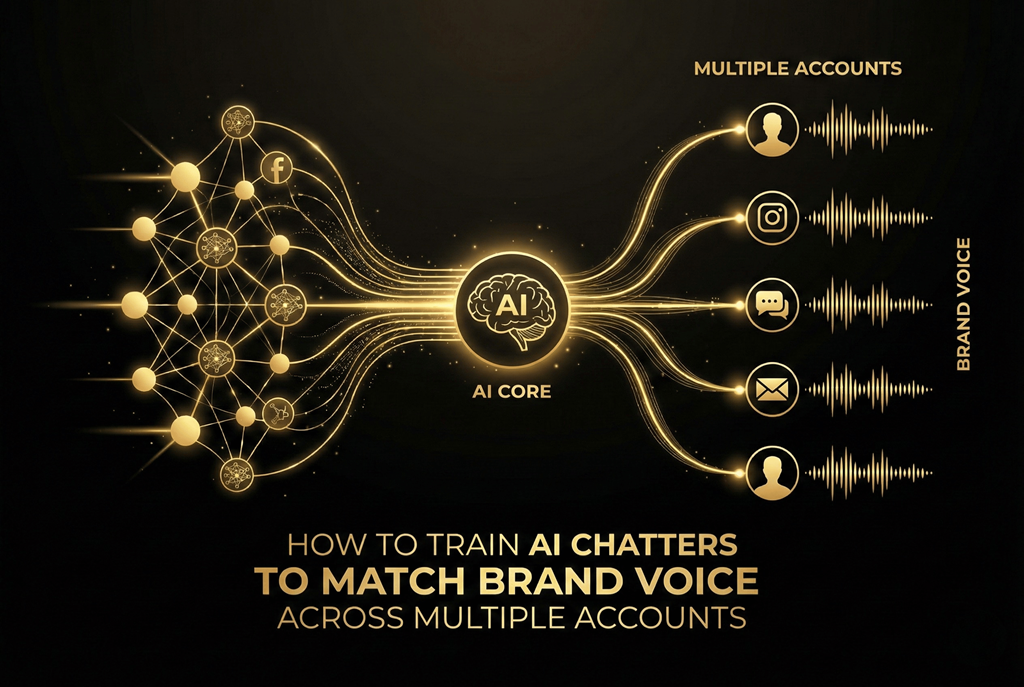
In the early days of social media automation, sounding human was enough. If an automated message avoided obvious scripts and passed as natural, it was considered successful. Today, that standard is no longer sufficient. In high-volume environments where agencies manage dozens of profiles simultaneously, the real challenge is not whether AI chatters sound human, but whether they sound aligned.
As conversational automation scales, inconsistency becomes visible. One account may sound confident and concise, another overly polite and verbose. One may escalate conversations quickly, another hesitate unnecessarily. These subtle differences erode trust, dilute brand identity, and create fragmentation across the messaging ecosystem. In multi-account operations, tone inconsistency is not cosmetic. It is structural.
Modern agencies operating advanced AI-powered social media automation systems understand that every message carries identity signals. Sentence length, emotional calibration, pacing, assertiveness, and conversational boundaries collectively define how a brand is perceived. When these signals fluctuate unpredictably across accounts, the brand loses cohesion. When they are overly standardized, messaging becomes repetitive and detectable.
This is why training AI chatters to match brand voice across multiple accounts is no longer a branding exercise. It is a strategic growth decision. Platforms evaluate messaging patterns holistically. Audiences subconsciously detect tonal drift. Conversion performance depends on conversational coherence. Scale amplifies both strengths and weaknesses.
A well-trained AI chatter does more than generate fluent replies. It operates within a clearly defined behavioral communication framework. It adapts to context without abandoning identity. It introduces variation without sacrificing consistency. It supports scalable outreach without creating linguistic footprints.
In this article, we explore how agencies can define brand voice structurally, embed it into contextual prompt architecture, scale it safely across multiple accounts, and continuously optimize conversational performance. When executed correctly, brand-aligned AI chat automation transforms from a generic efficiency tool into a controlled, scalable identity engine.
Defining Brand Voice as a Behavioral System
Most agencies approach brand voice as a stylistic preference. They describe it using surface-level adjectives such as “friendly,” “premium,” “bold,” or “approachable.” While these labels may guide copywriters loosely, they are insufficient for AI-powered conversational automation. AI chatters cannot reliably execute vague instructions. They require structure.
To scale AI chatters across multiple social media accounts, brand voice must be defined not as a mood, but as a behavioral communication system. This means translating identity into repeatable conversational mechanics that govern tone, rhythm, and decision-making in real time.
A behavioral brand voice includes measurable parameters. It defines how long responses typically are. It clarifies whether the brand initiates questions or waits. It establishes how directly offers are introduced and how quickly conversations progress toward intent. It determines the balance between curiosity and authority. These structural elements shape interaction far more than word choice alone.
For example, two brands may both describe themselves as “confident,” yet express it differently. One may use short, declarative sentences and minimal punctuation. Another may use longer, persuasive explanations with subtle emotional cues. Without explicitly mapping these tendencies, AI chat automation defaults to neutral corporate language, which dilutes identity and reduces differentiation.
Behavioral brand voice also governs emotional calibration. Does the brand escalate enthusiasm when users show interest, or does it maintain steady composure? Does it mirror the recipient’s tone, or anchor the conversation in its own personality? These decisions directly impact how conversations feel at scale, particularly in Instagram DM automation environments where first impressions shape conversion.
Another critical layer is conversational boundaries. A well-defined voice includes what the brand does not say. It restricts overuse of compliments, avoids exaggerated language, limits certain slang, and enforces tonal discipline. Without exclusion rules, AI systems tend to over-optimize for engagement, often producing overly agreeable or overly enthusiastic responses that feel artificial.
Defining voice behaviorally also protects against tone drift across multiple accounts. When agencies manage dozens of profiles, inconsistency becomes visible quickly. Some accounts may sound assertive, others hesitant. Some may push too quickly, others stall conversations. A behavioral framework ensures that AI chatters operate within controlled parameters, even as conversations vary naturally.
Importantly, brand voice must also align with platform expectations. Instagram conversations differ from email exchanges. Dating app interactions differ from professional outreach. A scalable voice system accounts for these contextual shifts while preserving core identity markers. This balance is essential for multi-account AI messaging strategies.
When brand voice is engineered as a behavioral system, it becomes trainable. AI prompts can reference sentence length guidelines, pacing rules, escalation thresholds, and tonal boundaries. Instead of improvising personality, AI chatters operate within clearly defined identity architecture.
Over time, this structured approach produces consistent conversational presence across accounts. Users recognize patterns subconsciously. Conversations feel coherent. Trust accumulates because communication appears intentional rather than reactive.
Ultimately, defining brand voice as a behavioral system transforms AI chatters from generic responders into identity carriers. It ensures that scale does not dilute personality, and that automation amplifies brand consistency instead of eroding it.
Training AI Chatters Through Contextual Prompt Architecture
Once brand voice is defined as a behavioral system, the next step is operationalization. This is where most agencies struggle. They understand tone conceptually, but fail to embed it into the mechanics of AI chat automation. Without structural guidance, even advanced language models revert to generic patterns.
Training AI chatters effectively requires contextual prompt architecture, not simple instruction layers. A prompt is not merely a sentence telling the AI to “sound friendly” or “be persuasive.” It is a layered framework that shapes response logic, emotional calibration, pacing, and conversational direction simultaneously.
At its core, contextual prompt architecture defines three elements: identity constraints, situational awareness, and behavioral objectives. Identity constraints preserve brand voice consistency. Situational awareness ensures replies respond to the specific message context. Behavioral objectives guide progression without forcing it.
For example, instead of instructing the AI to “move toward conversion,” agencies implement intent-aware progression rules. The AI evaluates conversation depth, user receptiveness, and timing before escalating tone or introducing offers. This reduces aggressive messaging signals and aligns conversations with natural human pacing.
Another essential component is memory integration. Effective AI-powered messaging systems track conversational state across exchanges. They recognize prior references, unanswered questions, emotional cues, and user hesitations. This memory allows AI chatters to respond cohesively rather than reactively.
Without contextual layering, AI responses feel disjointed. They may answer correctly, but lack continuity. Platforms like Instagram evaluate conversations holistically. Disconnected replies weaken behavioral credibility and increase detection risk in Instagram DM automation environments.
Prompt architecture must also define boundaries. Negative instructions are as important as positive ones. AI chatters should avoid over-explaining, avoid repetitive compliments, and avoid default enthusiasm. These guardrails prevent linguistic over-optimization, which often exposes automation patterns.
When managing multiple accounts, contextual prompts act as distributed behavioral control systems. Even as conversations differ across profiles, core identity parameters remain intact. This prevents tone drift while allowing situational flexibility.
Advanced agencies go further by implementing dynamic prompt adaptation. As conversations evolve, prompt emphasis shifts subtly. Early-stage exchanges prioritize curiosity and brevity. Mid-stage conversations introduce deeper engagement. Late-stage conversations refine intent progression. This phased structure mirrors natural social interaction and significantly reduces message limit risk.
Crucially, contextual prompt architecture transforms AI from a reactive responder into a controlled conversational engine. It enables scale without sacrificing personality. It preserves brand voice across dozens of accounts while adapting fluidly to individual conversations.
In high-volume outreach environments, this structure becomes the difference between sustainable automation and detectable pattern repetition. Contextual architecture absorbs scale because behavior is governed by layered logic rather than static templates.
Ultimately, training AI chatters through contextual prompt architecture ensures that automation remains adaptive, brand-aligned, and platform-safe. Without it, AI drifts toward neutrality. With it, AI becomes a strategic extension of identity.
Scaling Brand Voice Across Multiple Accounts Without Sounding Identical
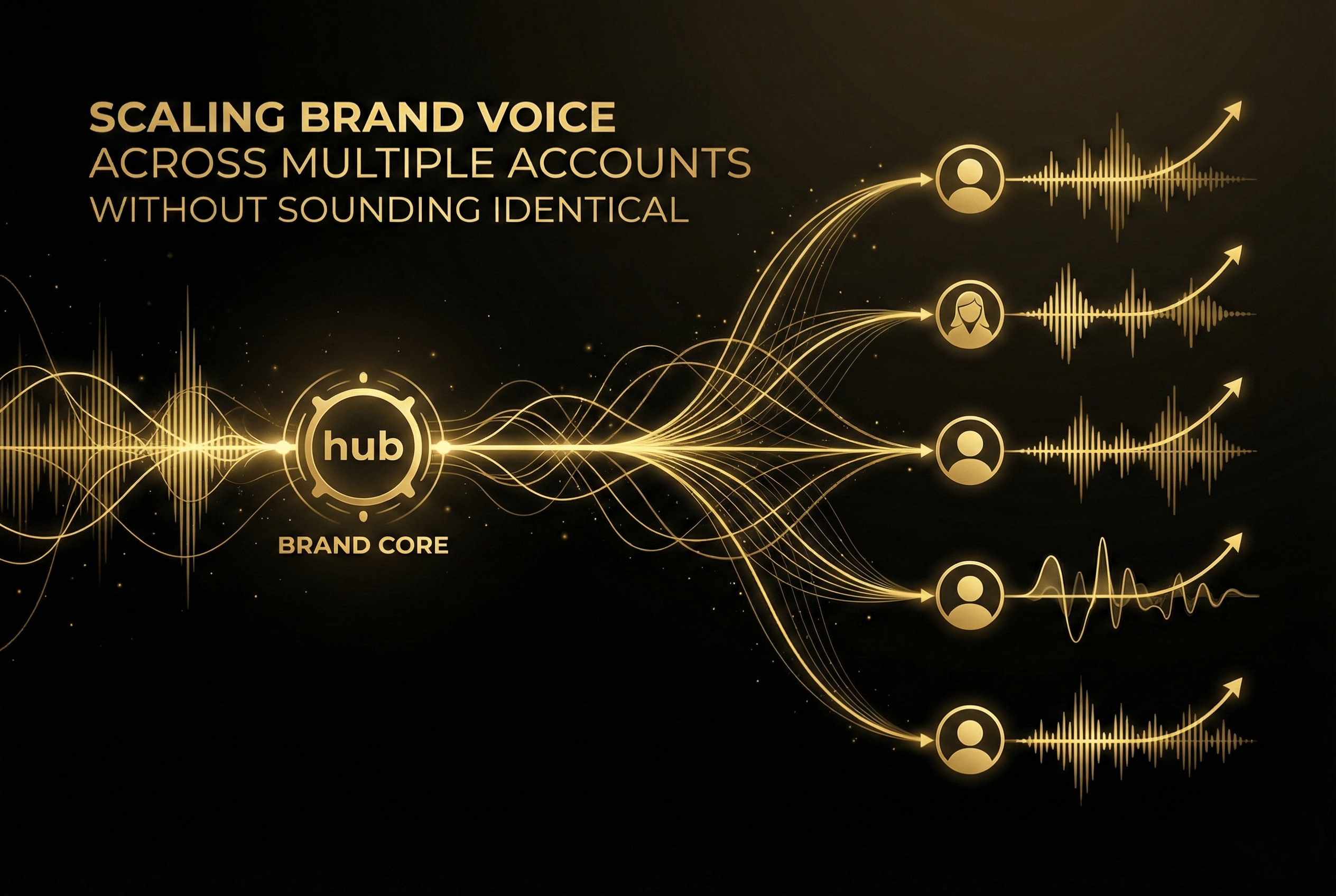
One of the most delicate challenges in AI-powered social media automation is achieving consistency without uniformity. When agencies scale across dozens of profiles, maintaining a recognizable identity becomes critical. Yet if every account communicates in exactly the same way, the result feels artificial, coordinated, and potentially detectable.
The objective is not duplication. It is alignment.
A scalable brand voice strategy for AI chatters must function like a shared foundation rather than a rigid script. Core identity markers remain stable across accounts: tone confidence, emotional calibration, conversational posture, and escalation logic. However, micro-variations are intentionally introduced to prevent linguistic overlap and behavioral correlation.
This is where many agencies fail. They over-standardize messaging in the name of consistency. Identical openers, identical transitions, and identical progression sequences create what platforms interpret as automation clustering. Even if each individual conversation feels natural, cross-account analysis exposes repetition patterns.
To scale safely, agencies must differentiate between core voice architecture and expressive surface variation. Core architecture defines how the brand behaves conversationally. Expressive variation defines how that behavior manifests in wording, pacing, and subtle stylistic cues.
For example, a brand defined as confident and direct may consistently avoid over-apologizing and maintain short, declarative responses. However, one account may express this confidence through concise statements, while another uses rhetorical questions. One may lean slightly playful, another slightly minimal. These micro-adjustments preserve brand integrity while diffusing detectable sameness.
From an algorithmic standpoint, this approach reduces linguistic footprint overlap across multiple accounts. Platforms like Instagram analyze message similarity at scale. When dozens of accounts produce near-identical phrasing patterns, risk increases dramatically. Controlled variation ensures that each conversational stream evolves uniquely.
Another critical element is pacing diversity. Even when brand tone remains stable, timing must vary organically between accounts. Some profiles may escalate conversations quickly. Others may progress more gradually. This diversity mirrors real human variation and strengthens multi-account automation safety.
Agencies that master this balance often implement tiered voice frameworks. Tier one defines universal brand traits. Tier two introduces account-level nuance. Tier three adapts dynamically to conversation context. This layered approach enables scale without collapsing into mechanical repetition.
Importantly, sounding identical is not only a detection risk. It is also a performance liability. Audiences subconsciously detect predictability. When multiple accounts feel interchangeable, trust erodes. Variation preserves authenticity and increases engagement depth.
Scaling brand voice effectively therefore requires intentional imperfection. Minor phrasing differences, slight tonal shifts, varied question styles, and fluctuating conversational energy create the illusion of independent human operators. In reality, these differences are strategically engineered.
Ultimately, scaling AI chatters across multiple accounts is an exercise in controlled diversity. Brand identity must be strong enough to remain recognizable, yet flexible enough to avoid pattern saturation. When executed properly, accounts feel unified but alive, coordinated but not duplicated.
In high-volume conversational ecosystems, this distinction determines whether scale remains invisible or becomes algorithmically exposed. Agencies that understand this nuance transform AI chat automation from a repetition engine into a distributed brand presence capable of sustainable growth.
Continuous Feedback Loops and Conversational Optimization
Training AI chatters is not a one-time configuration. In scalable environments, AI conversational systems must evolve continuously, or they gradually drift toward neutrality, repetition, or performance decline. The difference between automation that stagnates and automation that compounds results lies in the strength of its feedback architecture.
In high-volume AI-powered social media messaging, conversations generate enormous amounts of behavioral data. Reply depth, response time variance, conversation length, drop-off points, emotional tone shifts, and conversion triggers all create measurable signals. Agencies that ignore this data operate blindly. Agencies that structure it into continuous feedback loops build adaptive systems.
Conversational optimization begins with transcript analysis. Not to micromanage wording, but to identify patterns. Are AI chatters defaulting to longer responses over time? Are certain question types generating higher engagement? Are users disengaging after specific phrasing patterns? These insights reveal how brand voice behaves under real-world pressure.
Performance metrics also matter beyond engagement. Platforms evaluate conversations for quality signals such as sustained back-and-forth exchanges, user-initiated replies, and session continuity. When AI chat automation generates shallow interactions, message deliverability can decline silently. Continuous monitoring allows agencies to intervene before enforcement escalates.
Optimization also protects against tone drift across multiple accounts. As AI adapts to varied conversations, subtle deviations may emerge. One account may become overly assertive. Another may soften excessively. Without structured review, brand voice coherence erodes gradually. Feedback loops recalibrate tone boundaries and reinforce identity parameters.
Another critical dimension is contextual sensitivity. Platforms evolve constantly. Algorithm updates may adjust how messaging cadence, repetition patterns, or engagement depth are evaluated. Agencies operating advanced Instagram DM automation systems must adjust prompt architecture and pacing rules accordingly. Static setups become outdated quickly in dynamic ecosystems.
Feedback loops should therefore operate on multiple layers. Linguistic refinement ensures brand alignment. Behavioral analytics ensure safety. Conversion tracking ensures commercial effectiveness. Together, these layers create an adaptive conversational infrastructure rather than a static script engine.
Importantly, optimization does not mean maximizing intensity. Over-optimization often leads to overly polished messaging that feels artificial. Effective conversational refinement prioritizes believability over efficiency. Sometimes reducing verbosity increases engagement. Sometimes introducing more variability reduces detection risk. The goal is not perfection, but sustainable authenticity.
Agencies that institutionalize this process treat AI chatters as evolving assets. Prompt architecture is adjusted incrementally. Voice constraints are refined. Escalation pacing is recalibrated. Over time, this iterative process strengthens conversational resilience and platform trust.
Ultimately, continuous feedback loops transform AI chat automation into a living system. Instead of repeating patterns until restrictions occur, the system adapts proactively. Conversations remain aligned with brand voice, responsive to audience behavior, and compliant with platform expectations.
In scalable multi-account environments, optimization is not optional. It is the mechanism that allows AI chatters to grow more natural, more effective, and more platform-safe over time.
In high-scale environments, brand voice consistency becomes a competitive advantage. Agencies that train AI chatters to communicate with precision build recognition, trust, and conversion stability. Conversations feel intentional rather than improvised.
When brand voice is defined behaviorally, embedded contextually, diversified intelligently, and refined continuously, AI chat automation transforms from a generic tool into a structured growth asset.
Scaling across multiple accounts no longer dilutes identity. It amplifies it.
In modern social media automation, sounding human is essential. Sounding aligned is powerful. Agencies that master both unlock sustainable conversational scale without sacrificing credibility or control.