
Instagram Account Warm-Up Architecture for Long-Term Stability
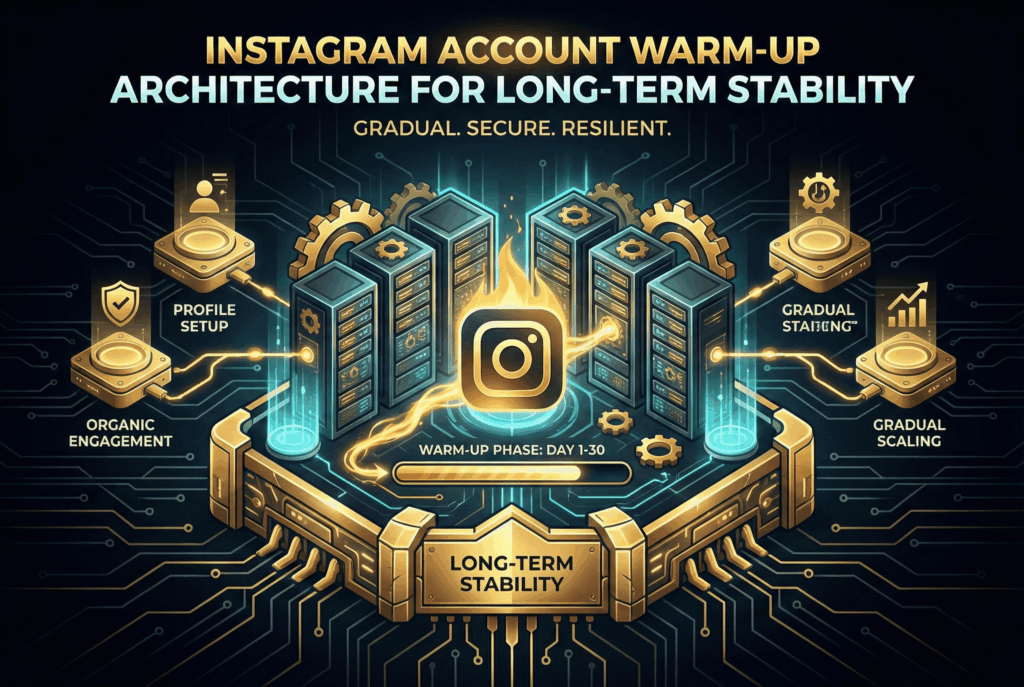
Most agencies treat Instagram account warm-up as a short onboarding phase. A few days of light activity. A gradual increase in engagement. Then full-scale outreach begins.
This approach is fundamentally flawed.
A proper Instagram account warm-up architecture is not a temporary precaution. It is the foundation of long-term account stability, deliverability health, and sustainable automation performance. Without it, even well-designed outreach funnels and diversified behavioral systems operate on unstable ground.
Instagram does not grant trust instantly. Trust accumulates through behavioral consistency over time. Warm-up is the process of constructing that trust deliberately and structurally.
Warm-Up Is Trust Accumulation, Not Activity Reduction
One of the most persistent myths in Instagram account warm-up strategy is that safety comes from doing less. Fewer actions. Minimal engagement. Avoiding messaging entirely for a fixed number of days. This interpretation reduces warm-up to passive waiting.
In reality, warm-up is not about inactivity. It is about trust accumulation through proportionate behavior.
Instagram’s detection systems evaluate accounts based on behavioral coherence over time. New or recently activated profiles begin with limited historical data. Without accumulated trust signals, any sudden spike in engagement, messaging, or follow activity appears disproportionate relative to account age and interaction history.
The platform does not ask whether an action is inherently acceptable. It asks whether that action makes sense within the account’s behavioral timeline.
This is why reducing activity alone does not create stability. An account that does nothing for a week and then suddenly initiates aggressive outreach still presents a discontinuity pattern. In contrast, an account that gradually introduces diversified interaction signals builds contextual legitimacy.
Warm-up must therefore be designed as progressive behavioral layering.
The first layer is passive presence. Consistent login sessions, browsing behavior, and light story viewing establish environmental continuity. These actions build session stability without triggering intensity markers.
The second layer introduces selective engagement. Likes, occasional comments, and subtle reactions distribute activity naturally. Importantly, this engagement should not follow mechanical volume increments. Real user behavior is irregular. Some days are lighter. Others slightly more active. Controlled variability prevents early pattern rigidity.
The third layer integrates interaction reciprocity. When engagement generates response signals—story replies, comment interactions, or profile visits—conversations can begin organically. Early messaging should remain contextual and low-pressure. The objective is dialogue depth, not conversion.
This structured layering accomplishes something critical: it aligns behavioral expansion with observable trust signals.
As Instagram registers consistent session continuity, diverse engagement patterns, and meaningful conversational exchanges, it recalibrates internal risk scoring for the account. Trust is not granted through time alone. It is granted through behavior that appears proportionate and organic.
Another key component of warm-up as trust accumulation is velocity modulation.
New accounts should not experience sudden shifts in daily activity intensity. However, they also should not increase engagement in perfectly linear increments. Linear growth curves are artificial. Organic activity fluctuates. Introducing slight irregularity during warm-up builds statistical realism into the account’s behavioral signature from the beginning.
Warm-up also interacts directly with future Instagram DM deliverability and outreach stability. Accounts that establish a foundation of reciprocal engagement and non-transactional conversation before introducing intent are less likely to trigger friction when messaging volume increases later.
In multi-account environments, this principle becomes even more important. If multiple accounts begin warm-up simultaneously and follow identical activity curves, correlation density forms at the earliest stage. Staggered onboarding and diversified early behavior prevent synchronized trust accumulation patterns.
Warm-up is therefore not a waiting period. It is the architectural phase where credibility is engineered deliberately.
Accounts that treat warm-up as inactivity often struggle with long-term instability. Accounts that treat warm-up as structured trust building develop durable behavioral baselines that support sustainable scaling.
Ultimately, Instagram account warm-up is not about limiting action. It is about aligning action with believable progression.
Trust does not emerge from silence.
It emerges from consistent, proportionate, and contextually coherent behavior over time.
Behavioral Gradualism and Natural Variability
A stable Instagram account warm-up architecture is not built on fixed timelines. It is built on behavioral realism. And behavioral realism depends on two structural principles: gradualism and variability.
Gradualism ensures that activity evolves proportionately over time. Variability ensures that evolution does not become mechanical.
Many agencies misunderstand gradual scaling. They create linear growth curves. Day one: minimal activity. Day two: slightly more. Day three: another incremental increase. While this may appear cautious, it introduces artificial predictability. Real users do not increase their platform engagement in clean, mathematical progressions.
Behavioral gradualism is not about fixed increments. It is about proportionate expansion aligned with interaction feedback.
If early engagement produces organic reciprocity—profile visits, story replies, comment exchanges—activity can expand modestly. If signals remain neutral, pacing should stabilize rather than accelerate. Gradualism adapts to response density instead of following a predetermined schedule.
This approach aligns with how Instagram evaluates behavioral trajectories. Sudden spikes in activity create anomaly signals. But equally, perfectly linear scaling curves can create statistical rigidity. Both extremes deviate from organic baselines.
Natural variability prevents this rigidity.
Real user behavior fluctuates. Some days are passive. Some days are interactive. Session lengths vary. Engagement intensity changes based on mood, availability, and interest. Incorporating controlled irregularity during warm-up embeds statistical authenticity into the account’s behavioral signature.
For example, instead of increasing engagement by the same percentage daily, activity might expand modestly one day, remain stable the next, and slightly contract afterward before growing again. This dispersion mirrors organic usage patterns and reduces early-stage pattern formation.
Natural variability also extends to interaction types.
Warm-up should not focus exclusively on one behavior dimension. Story viewing, light feed engagement, occasional comments, and profile exploration distribute activity across channels. Concentrating growth solely in one area—even at low volume—creates structural imbalance.
Diversified gradualism builds multidimensional trust signals.
Another critical dimension is conversational pacing. When messaging begins during warm-up, depth should expand organically. Some conversations may remain brief. Others may extend. Escalation should never follow identical timing thresholds across accounts. Engagement depth must determine progression.
In multi-account environments, behavioral gradualism must also account for correlation dispersion. Launching multiple accounts simultaneously and scaling them identically—even cautiously—creates synchronized behavioral signatures. Staggered onboarding combined with differentiated variability reduces network-level clustering risk.
Behavioral gradualism and natural variability work together to achieve one outcome: believable evolution.
Instagram’s systems analyze how accounts change over time. Accounts that evolve in proportion to interaction signals and fluctuate within realistic boundaries accumulate trust more effectively than accounts that follow rigid activation scripts.
Warm-up is not a countdown. It is a behavioral shaping phase.
When gradualism is adaptive and variability is intentional, accounts develop resilient behavioral baselines that support long-term stability. When scaling eventually accelerates, it does so on top of a foundation that already mirrors organic patterns.
In sustainable Instagram automation architecture, controlled unpredictability is not chaos. It is protection.
Gradualism builds trust. Variability protects it.

Infrastructure Stability During the Warm-Up Phase
Behavioral gradualism builds visible credibility. Infrastructure stability builds invisible credibility.
No Instagram account warm-up architecture can produce long-term stability if the technical foundation beneath it is inconsistent. Warm-up is not only about how an account behaves. It is about where and how that behavior is executed.
Instagram continuously evaluates device-level and session-level continuity. Even during early-stage activity, the platform observes device fingerprints, session persistence, login rhythm, IP stability, and environmental consistency. These technical signals form the structural identity of the account.
If infrastructure shifts repeatedly during warm-up, trust accumulation resets.
Accounts that rotate devices, change environments unpredictably, trigger frequent re-authentication cycles, or display unstable session patterns introduce anomaly markers at the exact stage where credibility should be forming. Behavioral caution cannot compensate for technical inconsistency.
Warm-up must therefore begin with infrastructure commitment.
Each account should operate from a stable, persistent environment from day one. Device identity should remain consistent. Session continuity should be preserved. Login timing should reflect realistic human patterns rather than abrupt, repeated resets.
Instagram’s systems do not evaluate behavior independently from environment. They analyze coherence between the two. When light engagement activity occurs within a stable technical framework, trust signals accumulate naturally. When identical activity occurs within a fluctuating environment, risk weighting increases.
Infrastructure stability also influences long-term Instagram DM deliverability.
Accounts that build early trust within consistent technical conditions often experience smoother messaging expansion later. Conversely, accounts that display environmental instability during warm-up frequently encounter unexpected friction when outreach begins, even if behavioral scaling remains conservative.
Another critical factor is segmentation in multi-account ecosystems.
If multiple accounts enter warm-up simultaneously using identical infrastructure configurations, correlation density forms at the technical layer before messaging even begins. Shared environmental fingerprints across new accounts create clustering signals that can persist throughout the lifecycle of the network.
Staggered onboarding and segmented infrastructure prevent synchronized technical baselines. Each account develops its own continuity history rather than participating in a shared technical signature.
Infrastructure stability during warm-up also protects against future algorithm refinement.
Detection systems evolve. Technical scrutiny intensifies incrementally. Accounts that established early-stage continuity within stable environments are more resilient to these refinements because their historical patterns remain coherent.
Warm-up is the only phase where infrastructure can be anchored cleanly before high-intensity activity begins. If instability exists at this stage, scaling later magnifies it.
Importantly, infrastructure stability is not about concealment. It is about realism.
Real users do not log in from radically different device contexts every few days. They maintain predictable usage patterns. When automation mirrors this consistency, it aligns with platform expectations instead of deviating from them.
In a properly designed Instagram warm-up strategy, behavioral progression and technical continuity evolve together. Activity increases gradually within a stable environment. Session history lengthens without disruption. Trust compounds instead of fragmenting.
Infrastructure is silent when it works correctly. But when it is unstable, it undermines every other protective layer.
During warm-up, stability is not optional. It is foundational.
From Warm-Up to Sustainable Velocity
The true purpose of a structured Instagram account warm-up architecture is not caution. It is controlled acceleration.
Warm-up that never transitions into scalable activity is wasted time. But scaling without a structured transition destroys accumulated trust. The critical phase is not warm-up itself. It is the shift from foundational stability to sustainable Instagram automation velocity.
This transition must be evolutionary, not abrupt.
One of the most common structural mistakes agencies make is treating warm-up as a temporary safety buffer. After a defined number of days, they activate full outreach, increase engagement volume significantly, and introduce aggressive escalation logic. From an operational perspective, this feels like “unlocking growth.” From an algorithmic perspective, it creates behavioral discontinuity.
Instagram evaluates trajectory, not just activity.
If the account’s behavioral curve shifts too sharply, anomaly detection models assign elevated risk weight. Sudden expansion in DM volume, engagement intensity, or session duration breaks the continuity established during warm-up. Trust that was slowly accumulated becomes destabilized by disproportionate growth.
The transition toward velocity must therefore remain proportional.
Activity expansion should be linked to interaction feedback. If engagement depth increases and reply rates remain strong, velocity can rise modestly. If friction signals appear—lower reply density, subtle deliverability issues, increased verification prompts—expansion should pause rather than accelerate.
Sustainable velocity is adaptive, not fixed.
Another critical factor is distribution.
Instead of increasing all behavioral dimensions simultaneously, agencies should layer velocity expansion. Engagement intensity may rise first. Messaging cadence may expand slightly afterward. Escalation depth can increase only once conversational quality remains stable. This staggered approach prevents synchronized spikes that amplify detection risk in multi-account Instagram automation systems.
Sustainable velocity also requires preserving natural variability.
Even as activity increases, daily fluctuations must remain. Not every day should operate at peak intensity. Some sessions should remain shorter. Some engagement windows lighter. Maintaining controlled irregularity prevents the formation of high-density behavioral clusters.
Infrastructure stability must continue uninterrupted during this phase. Velocity layered on unstable technical conditions magnifies risk exponentially. Stable device continuity and session persistence allow behavioral scaling to compound rather than fragment trust signals.
Another overlooked element is conversation-based scaling.
Accounts should increase outbound messaging only when conversational momentum supports it. Higher Instagram DM reply rates justify moderate expansion. Low reply density suggests the need for optimization rather than additional volume. Velocity should follow engagement quality, not precede it.
In multi-account environments, the transition from warm-up to velocity must also be dispersed across the network. If multiple accounts accelerate simultaneously, synchronized behavioral curves form. Staggered scaling protects against cross-account correlation.
Sustainable velocity is therefore not about maximizing activity. It is about maintaining coherence while expanding output.
Accounts that transition gradually retain deliverability stability. DM limits remain flexible. Escalation can occur based on engagement depth rather than defensive caution. Long-term performance becomes predictable rather than volatile.
Ultimately, warm-up is the architectural foundation. Sustainable velocity is the structural extension built on top of it.
When growth emerges from continuity rather than compression, automation becomes resilient.
In scalable Instagram growth systems, the objective is not rapid acceleration. It is durable acceleration.
Warm-up builds trust. Sustainable velocity preserves it.
In scalable Instagram automation architecture, long-term stability is not achieved by staying below arbitrary limits. It is engineered through progression, variability, and technical consistency.
An effective Instagram account warm-up strategy builds behavioral credibility layer by layer. It introduces activity gradually. It preserves natural irregularity. It anchors trust in stable infrastructure. It transitions into outreach without compression.
Agencies that rush warm-up often spend months managing restrictions. Agencies that architect warm-up intentionally build accounts capable of scaling sustainably.
Growth on Instagram does not begin with outreach.
It begins with trust.
And trust is built through architecture, not speed.
Don't stop at reading.
Join the community or pick a plan and start automating today.
Get help, share wins, stay ahead.
Thousands of operators, direct support from the team, and a live feed of updates, tips and drops.
- Live support and troubleshooting from the team and power users
- Setup walkthroughs, targeting tips and workflow templates
- Early word on new bots, features and releases
Ready to put growth on autopilot?
Run your accounts, clients or traffic funnel while Onimator does the work. Start scaling today.
- Unlimited accounts
- All available tasks
- Integrated AI Chatter
- Up to 7 devices