
Instagram Shadow Filtering vs Shadowban: What’s Actually Happening to Your Reach
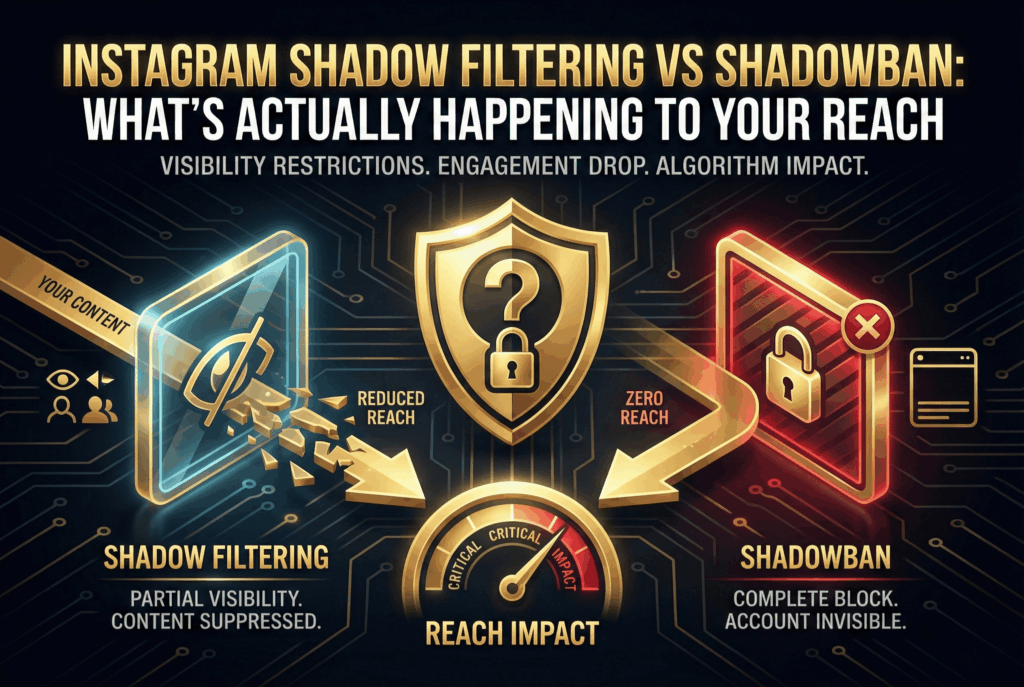
Few topics in the world of Instagram growth and automation generate as much confusion as the idea of a shadowban. When reach suddenly drops, engagement weakens, or DMs start landing in Requests, the immediate assumption is clear: the account has been shadowbanned.
But in reality, most cases are not true bans.
What users experience far more often is Instagram shadow filtering — a gradual algorithmic adjustment that reduces visibility without fully restricting the account. Understanding the difference between a shadowban vs shadow filtering is critical for agencies managing multiple accounts, scaling automation systems, or protecting long-term reach stability.
If your reach has declined, what is actually happening behind the scenes?
What People Call a “Shadowban” on Instagram
The term Instagram shadowban has become one of the most overused explanations for declining visibility. Whenever reach drops, hashtags stop generating impressions, or Explore traffic disappears, the immediate assumption is that Instagram has silently penalized the account. This narrative spreads quickly because the effects feel abrupt and difficult to explain through surface-level metrics.
In reality, what most users describe as a shadowban on Instagram is rarely a formal restriction.
A true enforcement action typically follows clear violations of platform policies. These situations often involve repeated spam behavior, prohibited content, or aggressive automation patterns, and they are frequently accompanied by visible signals such as action blocks, removed posts, or warnings. What agencies and creators usually experience instead is a decline in Instagram reach distribution driven by algorithmic recalibration rather than punishment.
The confusion arises because Instagram’s ranking system operates probabilistically rather than uniformly. Content is not automatically shown to all followers or broadly distributed through hashtags. Instead, distribution expands or contracts based on engagement performance and behavioral credibility. When a post is published, it is initially shown to a limited portion of the audience. If early signals such as watch time, saves, comments, and interaction velocity meet or exceed historical benchmarks, distribution expands. If those signals weaken, amplification contracts.
This contraction can feel indistinguishable from suppression.
However, the system is not necessarily banning the account. It is adjusting exposure based on perceived value and engagement strength. When performance declines relative to prior baselines, Instagram algorithm visibility decreases proportionally. The account remains active and compliant, but its content is prioritized less aggressively.
Another reason the myth of the shadowban persists is the lack of granular transparency. Instagram does not provide detailed breakdowns explaining why distribution changed. When impressions decline by 30%, 50%, or more within a short period, it is natural to interpret the shift as a penalty. Without insight into ranking recalculations, the term “shadowban” becomes a convenient explanation.
In reality, reach is dynamic and influenced by multiple layers of signals.
Changes in audience behavior, increased competition within a niche, reduced engagement consistency, or fluctuations in posting rhythm can all affect distribution weighting. Even subtle behavioral shifts, such as declining story interactions or reduced Instagram DM engagement quality, may contribute to a gradual reduction in algorithmic confidence.
In multi-account or automation-heavy environments, additional factors come into play. If several accounts exhibit synchronized posting windows, identical escalation pacing in DMs, or compressed engagement patterns, clustering models may reduce amplification priority. This does not indicate that the accounts are banned; rather, it reflects a decrease in algorithmic trust due to detectable structural similarity.
From the outside, the experience resembles a shadowban.
From a systems perspective, it is a recalibration of exposure probability.
The concept of a shadowban vs shadow filtering simplifies a complex ranking ecosystem into a binary interpretation. In reality, Instagram reach decline usually reflects a sliding scale of trust adjustment. Exposure increases when engagement signals strengthen and decreases when those signals weaken.
Understanding this distinction is critical for agencies managing growth at scale. Misdiagnosing a reach contraction as a ban often leads to reactive decisions such as aggressively increasing posting frequency, changing hashtag sets abruptly, or restructuring content without data-backed analysis. These sudden shifts can further destabilize behavioral consistency and reinforce algorithmic caution.
Most cases labeled as Instagram shadowban are better understood as shifts in algorithmic confidence rather than silent penalties. Recognizing this allows for strategic correction focused on improving engagement depth, restoring behavioral dispersion, and stabilizing interaction patterns instead of responding defensively to a perceived ban.
In the vast majority of scenarios, the account has not been hidden.
The system has simply recalculated how much visibility it currently deserves.
Understanding Instagram Shadow Filtering
While the term Instagram shadowban dominates online discussions about declining reach, a more accurate and technically precise concept in most scenarios is Instagram shadow filtering. Unlike a ban, which implies a punitive enforcement action triggered by policy violations, shadow filtering represents a dynamic algorithmic adjustment in distribution weight. The account remains active, content remains visible, but amplification is reduced because the system has lowered its confidence in how broadly that content should be distributed.
To understand Instagram shadow filtering, it is important to recognize that Instagram reach distribution operates on a probability model rather than a fixed guarantee. Every post, story, reel, and even direct message interaction is evaluated within a framework of engagement signals, historical performance, audience responsiveness, and behavioral consistency. When those signals weaken or become structurally inconsistent, the system reduces exposure proportionally rather than applying a visible restriction.
This reduction is rarely absolute and almost never binary.
Instead of hiding content entirely, the algorithm narrows its initial distribution pool. Hashtag impressions may decline significantly, Explore page placement may disappear, and story reach may shrink to a smaller segment of followers. In automation-heavy ecosystems, even Instagram DM deliverability can be subtly affected because messaging trust scoring and content distribution scoring are interconnected through broader behavioral evaluation.
From a user perspective, the experience feels like suppression because performance drops quickly compared to historical averages. From the platform’s perspective, however, this is a recalibration of distribution confidence rather than a disciplinary action.
Shadow filtering typically develops gradually because it is influenced by cumulative signals. Declining engagement depth, reduced save rates, lower comment quality, inconsistent posting cadence, or compressed behavioral patterns can all contribute to decreasing Instagram algorithm visibility. None of these factors individually create a “ban,” but together they reduce the system’s incentive to amplify the account.
In multi-account or automation-driven environments, shadow filtering in Instagram automation systems becomes even more nuanced. When multiple accounts operate with synchronized posting windows, identical escalation timing in DMs, or repetitive engagement structures, clustering models may detect behavioral symmetry. The result is often reduced amplification priority rather than explicit restriction. The accounts are still functional, but their content is distributed more conservatively.
The difference between shadow filtering vs shadowban therefore lies in intent and structure. A ban implies rule enforcement and violation consequences. Filtering reflects algorithmic recalibration based on engagement and trust modeling.
Because filtering is performance-driven, it is also reversible. Accounts that improve engagement quality, stabilize behavioral patterns, and reintroduce timing variability often experience gradual reach recovery. The recovery is rarely instant because confidence rebuilds incrementally through sustained positive signals.
Competitive dynamics also play a significant role. In saturated niches, small engagement fluctuations can drastically affect exposure. If competing content performs better in the same time frame, distribution may shift away from your account without any punitive filtering at all. These competitive redistributions are frequently misinterpreted as shadowbans when they are actually normal algorithmic prioritization shifts.
Understanding Instagram shadow filtering allows agencies to respond strategically instead of reactively. Increasing posting volume aggressively or making abrupt structural changes often worsens instability because it introduces new behavioral compression. Instead, restoring engagement depth, improving interaction quality, and stabilizing posting rhythm strengthen algorithmic trust over time.
In advanced Instagram growth architecture, reach is continuously recalculated based on credibility, consistency, and audience response. Shadow filtering is not a hidden punishment system; it is a dynamic visibility adjustment mechanism designed to optimize user experience.
Recognizing this distinction helps agencies diagnose reach declines accurately and implement structural corrections rather than chasing the myth of an invisible ban.

Behavioral Triggers That Reduce Reach
In most cases, declining visibility is not caused by an official restriction but by accumulated behavioral triggers that reduce Instagram reach over time. These triggers are rarely dramatic or obvious. Instead, they build gradually as engagement patterns, posting rhythm, and interaction quality shift in ways that lower algorithmic confidence.
One of the most significant factors is declining engagement depth.
Instagram evaluates not only how many interactions a post receives, but how meaningful those interactions appear. Superficial likes without comments, short watch times on Reels, low save rates, or shallow story replies all weaken Instagram engagement signals. When content repeatedly underperforms relative to historical benchmarks, the system reduces distribution probability. The account is not banned; it is simply deprioritized in ranking calculations.
Another critical trigger is behavioral compression.
If posting occurs within narrow, repetitive time windows, or if engagement spikes appear unnaturally synchronized, pattern density increases. Real user ecosystems display natural variability in activity. When accounts operate with overly consistent timing—especially in multi-account Instagram automation systems—the algorithm may interpret this uniformity as coordinated behavior, which can lead to reduced amplification priority.
Shallow outbound messaging also contributes to reach contraction.
Low Instagram DM engagement quality, such as messages that generate minimal replies or short, transactional exchanges, affects broader trust modeling. Instagram’s ecosystem evaluates relational credibility across content and messaging layers. If conversations consistently fail to produce depth, overall account trust signals weaken, which can indirectly influence content distribution.
Sudden scaling shifts are another common trigger.
Abrupt increases in posting frequency, dramatic changes in content style, or rapid escalation of outreach volume can destabilize historical engagement patterns. Algorithms favor gradual behavioral evolution. When accounts change too quickly, especially after periods of lower activity, distribution may temporarily contract while the system recalibrates performance expectations.
Repetitive content structure also plays a role.
Even if topics vary, highly similar caption formats, identical call-to-action placement, or uniform emotional arcs across posts can reduce perceived originality. Over time, this structural repetition weakens Instagram algorithm visibility, particularly in competitive niches where differentiation is critical.
Audience mismatch can compound these issues.
If content consistently reaches followers who do not interact meaningfully—due to outdated targeting, poor hashtag alignment, or engagement pods—the system learns that amplification yields weak results. This feedback loop reduces future exposure probability, further accelerating reach decline.
In automation-heavy environments, clustering risk becomes more pronounced. When multiple accounts exhibit synchronized posting schedules, similar engagement curves, and identical escalation pacing, cross-account similarity can influence how distribution models assign confidence. While this does not automatically result in penalties, it can lead to cautious reach allocation across the network.
Understanding these behavioral triggers that reduce reach is essential for agencies diagnosing performance drops. Most visibility declines are not the result of hidden bans but of measurable structural signals that indicate reduced engagement value or increased pattern similarity.
Correcting these triggers requires stabilizing posting rhythm, improving engagement depth, diversifying behavioral timing, and maintaining structural variability. When trust signals strengthen consistently, distribution probability increases accordingly.
In advanced Instagram growth strategy, reach is not fixed or guaranteed. It is continuously negotiated through performance credibility, behavioral dispersion, and sustained audience interaction quality.
Why Reach Drops Gradually Instead of Instantly
One of the most misunderstood aspects of declining visibility is the pace at which it happens. When users search for answers about a perceived Instagram shadowban, they often expect a binary explanation: either the account is fully visible or it has been suddenly restricted. In reality, Instagram reach decline rarely occurs overnight because the platform’s ranking systems operate on progressive confidence adjustments rather than immediate enforcement triggers.
Instagram’s distribution model is built on probability layers.
Every piece of content is evaluated against historical performance benchmarks, audience responsiveness, engagement depth, and behavioral consistency. When those signals weaken, the algorithm does not immediately suppress the account. Instead, it reduces distribution incrementally. Initial reach to followers may shrink slightly. Explore impressions may decrease. Hashtag visibility may taper off. These reductions compound across multiple posts, creating the perception of a shadowban.
This gradual contraction reflects recalibration rather than punishment.
The platform continuously recalculates Instagram algorithm visibility based on how confidently it predicts that content will generate meaningful engagement. If recent posts underperform relative to previous averages, the system becomes more conservative with distribution. Each subsequent post must rebuild confidence through stronger early engagement signals to reverse the contraction.
Behavioral shifts also influence the speed of decline.
If posting frequency changes abruptly or engagement quality drops due to audience fatigue, reach reduction typically unfolds over several content cycles rather than instantly. The system observes patterns over time. Consistent underperformance gradually lowers amplification weight. Conversely, sustained improvement gradually restores it.
In automation-heavy environments, the same principle applies at scale.
When multiple accounts display synchronized posting windows, compressed engagement patterns, or identical structural shifts, cross-account similarity may influence distribution modeling. However, even in these cases, amplification usually decreases progressively rather than disappearing immediately. The algorithm evaluates cumulative signals before adjusting exposure thresholds.
Competitive dynamics further explain gradual decline.
Instagram’s feed and Explore algorithms allocate limited visibility space across millions of posts. If competing content within a niche performs more strongly over time, your relative distribution share may shrink without any filtering mechanism applied. This competitive redistribution is often misinterpreted as a penalty when it is actually performance-based reallocation.
Another important factor is engagement decay.
Audience interest naturally fluctuates. If follower responsiveness decreases gradually, perhaps due to content repetition or misaligned targeting, reach contracts proportionally. The algorithm detects reduced interaction probability and adjusts exposure weight accordingly. This process unfolds incrementally because it is based on rolling performance averages rather than single data points.
The key distinction between shadow filtering vs shadowban becomes clear in this context. A true restriction triggered by policy violations may produce immediate limitations or visible warnings. In contrast, Instagram shadow filtering manifests as a slow recalibration of distribution confidence. The account remains active, but its content is distributed more cautiously until engagement signals strengthen.
Understanding why reach drops gradually is essential for accurate diagnosis.
Reacting impulsively to early signs of decline—by dramatically increasing posting volume or changing strategy abruptly—can further destabilize engagement patterns. Sustainable recovery requires restoring consistency, improving interaction depth, and reintroducing natural behavioral variability.
In advanced Instagram growth architecture, reach behaves like a trust curve rather than a switch. It rises with sustained performance and declines when signals weaken over time. Recognizing this progression allows agencies to focus on structural correction instead of assuming invisible punishment.
Because in most scenarios, the platform is not removing visibility in a single action.
It is adjusting exposure gradually based on evolving confidence signals.
The majority of cases labeled as Instagram shadowban are better understood as shadow filtering driven by behavioral signals.
Reach declines when engagement weakens, when automation compresses natural variability, or when structural similarity compounds across accounts. It is rarely the result of a single invisible punishment. More often, it is an algorithmic confidence adjustment.
The solution is not panic or volume increase.
It is structural correction.
Rebuild conversation depth. Disperse timing patterns. Stabilize infrastructure. Avoid synchronized behavioral shifts across multiple accounts. Focus on organic interaction signals rather than aggressive scaling.
In advanced Instagram automation architecture, reach is not guaranteed. It is earned continuously through behavioral credibility.
Shadow filtering reflects reduced trust.
Restoring reach requires restoring that trust — gradually, structurally, and sustainably.
Understanding this distinction allows agencies to diagnose reach drops accurately and respond strategically instead of reactively.
Because in most cases, nothing is “banned.”
The system is simply recalibrating.
Don't stop at reading.
Join the community or pick a plan and start automating today.
Get help, share wins, stay ahead.
Thousands of operators, direct support from the team, and a live feed of updates, tips and drops.
- Live support and troubleshooting from the team and power users
- Setup walkthroughs, targeting tips and workflow templates
- Early word on new bots, features and releases
Ready to put growth on autopilot?
Run your accounts, clients or traffic funnel while Onimator does the work. Start scaling today.
- Unlimited accounts
- All available tasks
- Integrated AI Chatter
- Up to 7 devices