
The Trust-Device Trap: Why Fresh Accounts Fail Your Automation

An operator onboards ten fresh Instagram accounts on Monday. Standard setup, well-configured proxies, clean device fingerprints, textbook automation configuration copied from accounts that have been running clean for months. By Friday, three of the accounts are locked behind verification challenges the operator can barely keep up with. By the following Monday, five of them have received feature limits or worse. The operator reviews the automation configuration, finds nothing wrong, and concludes that Instagram must have tightened detection.
The automation configuration is not the problem.
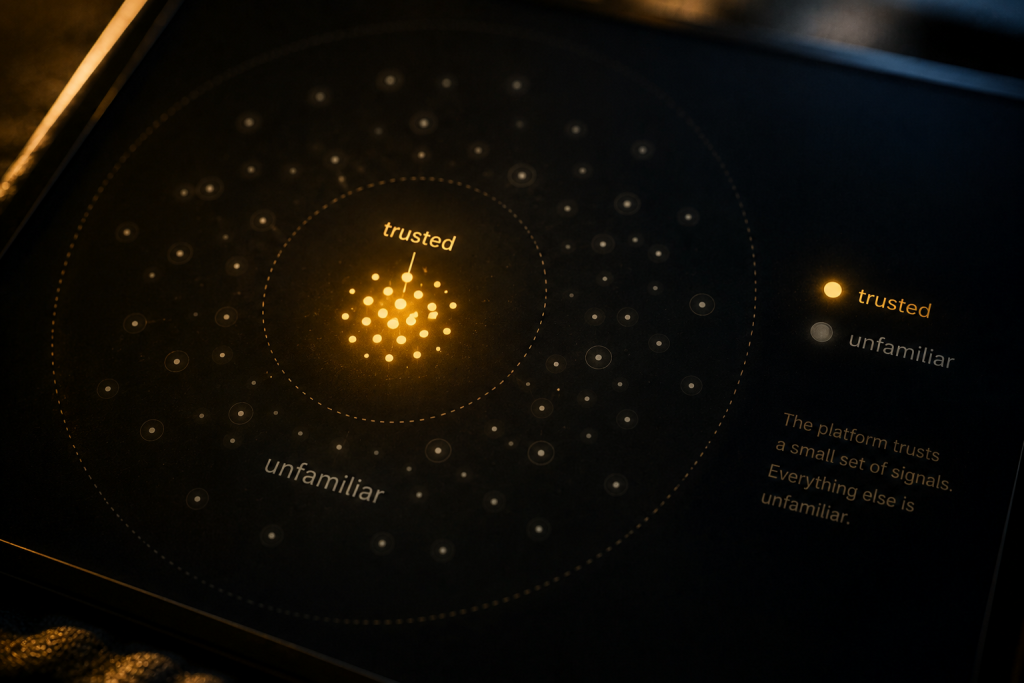
The problem is that the accounts never got the chance to establish trust with the platform on the devices and networks they are running on, and every session those accounts execute reads to Instagram as a potentially unauthorized login rather than a legitimate account holder resuming normal use. The suspicious login attempts compound. The login verification challenges cascade. The account never accumulates the consistent-context signals that would move it into the platform’s trusted-device model, and the platform’s high-scrutiny posture keeps generating restrictions that automation configuration alone cannot fix.
This is the trust-device trap. It affects almost every multi-account operator during onboarding, produces restrictions that look like automation failures, and gets misdiagnosed constantly.
The automation is not what Instagram is judging. The relationship between the account and its runtime context is.
What Instagram Actually Sees When Fresh Accounts Log In
Instagram’s security system maintains a profile of each account’s normal login patterns — the devices the account has previously logged in from, the IP ranges those devices connected through, the approximate geographic locations, and the general time-of-day patterns when logins usually occur. Every incoming login gets evaluated against that profile, and logins that diverge sharply from established patterns get flagged as suspicious. The response ranges from silent logging through verification challenges through outright login blocks depending on how strongly the divergence suggests unauthorized access.
Fresh accounts have no established profile. There is nothing for Instagram to compare against, because the account has no login history. Every early session is by definition divergent from a pattern that does not exist yet. The platform’s response defaults to the high-scrutiny posture — verification challenges on nearly every login, alerts to the registered email and phone for every new session, and heightened sensitivity to any behavioral signals that would look normal on an aged account with established trust.
The trust-building path exists but takes time. When the account logs in from the same device across multiple sessions, when the IP addresses stay within similar ranges, when the login times cluster around consistent patterns, Instagram gradually accumulates evidence that this specific device and network context is the account’s normal environment. After enough consistent sessions, the device transitions into the trusted list, and subsequent logins from that device face materially less scrutiny.
The critical operational reality is that this transition requires consistency. The account has to use the same runtime environment across multiple sessions for the platform to recognize that environment as legitimate. Rotate the environment aggressively during the trust-building window and the process resets — the platform never sees enough consistent-context signals to establish trust, and the account remains in the fresh-account high-scrutiny posture indefinitely.
Why Aggressive Onboarding Makes This Worse
The onboarding practices most operators use are optimized for the wrong outcome. Rotating IPs aggressively, switching device fingerprints between sessions, running automation from the first day the account is created — these are the practices that make sense for accounts that already have established trust and need to maintain per-account isolation across a fleet. They are exactly wrong for accounts that have not yet earned trust and need to accumulate consistent-context signals.
The mechanism is straightforward once the trust model is understood. Every rotation event resets the pattern the platform was starting to recognize. An account that logs in from IP A on Monday, IP B on Tuesday, IP C on Wednesday never accumulates enough Monday-consistent, Tuesday-consistent, Wednesday-consistent signals to establish any of those IPs as normal. The platform sees a rotating pattern that looks similar to what it would see from an attacker trying different network locations to gain access, and treats each session as unfamiliar even after weeks of the same underlying operator running the account.
Device rotation compounds the same problem. Fresh accounts that get assigned to different runtime devices across their first month never build trust with any specific device, and the trusted-device list stays empty. Every session on every device produces the fresh-device high-scrutiny response, and the operator interprets the resulting friction as automation failure rather than as the trust-establishment process being deliberately prevented.
Immediate automation dispatch adds a third layer. Fresh accounts that start following, liking, and commenting from the first day face behavioral scrutiny in addition to the login scrutiny they were already going to receive. The automation may be textbook safe by aged-account standards, but on a fresh account with no established behavioral baseline, even conservative automation reads more suspicious than the same automation would on an established account.
The Consistency Window That Actually Works

The onboarding pattern that produces accounts with strong long-term stability looks almost the opposite of what most operators intuitively want to do. The account gets assigned to a specific runtime device and stays on that device across the entire onboarding window. The proxy assignment stays stable — the same IP for every session across the first two weeks rather than rotating between sessions. The login times cluster around a consistent window that matches the account’s supposed timezone. No aggressive automation runs during this period. What runs looks like a real user browsing casually, engaging occasionally, and generally behaving like a person exploring the platform.
The behavioral pattern during onboarding matters as much as the infrastructure pattern. Warm-up activity during this window should look like a real user’s early Instagram exploration — story views of accounts the operator might plausibly follow, occasional likes on posts, occasional profile visits, no follow spam, no comment automation, no DM outbound. The account is building both device trust and behavioral trust simultaneously, and rushing either process undermines both.
Login alerts and verification challenges that arrive during the onboarding window should be handled deliberately rather than dismissed. Every login alert the platform generates should be confirmed through the alert’s confirmation flow, which teaches the system to trust the current runtime context. Every verification challenge that requires a code should be completed cleanly rather than retried repeatedly or abandoned. Failed challenges accumulate negative signal against the account’s trust score, and accounts that fail multiple challenges during onboarding often never recover to normal operational posture.
Two-factor authentication setup during the first week is another lever that pays off long-term. Enabling 2FA on the fresh account and configuring it through an authenticator app that the automation platform can integrate with reduces the frequency of verification challenges after the initial setup and provides a stronger security signal that improves the account’s trust profile over time.
This entire window typically runs one to three weeks depending on how quickly the account accumulates enough consistent-context evidence to earn full trusted-device status. Only after the window closes should the operator begin normal operational automation and only then should any rotation of IPs, devices, or behavioral patterns be introduced.
Why the Data Feels Backwards
Operators evaluating the tradeoff typically resist the slow-onboarding approach because it feels operationally expensive. Two weeks of stability-focused onboarding per account, across a fleet of dozens of accounts, adds up to substantial time before any account produces meaningful automation output. Compared to the alternative of running automation from day one, the slow approach looks like leaving revenue on the table.
The math actually works the other way once you measure across a longer horizon. Accounts that missed the trust-building window rarely produce sustained automation output because they remain in the semi-verified state where every session triggers friction and the platform’s baseline scrutiny keeps producing restrictions. Fleets of accounts onboarded aggressively often see 40 to 60 percent attrition within the first two months, which means most of the effort spent onboarding those accounts produces nothing usable.
Fleets onboarded with the consistency-focused approach see much lower attrition, often under 15 percent through the same window, and the accounts that survive produce substantially more output per month because they operate from the trusted-device posture rather than the fresh-account posture. The aggregate output over six months typically exceeds the aggregate output of the fast-onboarded fleet by a wide margin, even though the slow fleet produced nothing during the first two weeks per account.
How to Recover Accounts That Missed the Window
Accounts that are already stuck in the semi-verified state can sometimes be recovered, but the process is slower than doing onboarding correctly in the first place. The recovery approach mirrors the correct onboarding approach in principle. Pause aggressive automation on the affected account entirely. Assign it to a stable runtime device and hold it there for at least three to four weeks without rotation. Route it through a consistent IP over the same window. Reduce activity to warm-up-like patterns rather than operational automation, giving the account time to accumulate the consistent-context signals it never got the chance to accumulate during initial onboarding.
Confirm every pending login alert through its confirmation flow. Complete verification challenges cleanly when they appear. Handle 2FA setup if it was not configured during onboarding. Watch for the frequency of new friction events to decline over the recovery window — that decline is the signal that trust is rebuilding, and only after friction drops materially should the operator begin cautiously reintroducing normal automation.
Some accounts will not recover regardless of how patiently the recovery process is run. Accounts that accumulated too much negative signal during the aggressive-onboarding period, or that received account warnings before the operator recognized what was happening, often remain in the reduced-trust posture permanently. These accounts should be retired from operational use before further investment gets sunk into recovering them, and replaced with fresh accounts onboarded correctly from day one.
Trust is the resource the automation is really running on. Everything else is downstream of it.
Don't stop at reading.
Join the community or pick a plan and start automating today.
Get help, share wins, stay ahead.
Thousands of operators, direct support from the team, and a live feed of updates, tips and drops.
- Live support and troubleshooting from the team and power users
- Setup walkthroughs, targeting tips and workflow templates
- Early word on new bots, features and releases
Ready to put growth on autopilot?
Run your accounts, clients or traffic funnel while Onimator does the work. Start scaling today.
- Unlimited accounts
- All available tasks
- Integrated AI Chatter
- Up to 7 devices