
YouTube Comment Automation: Increasing Visibility Without Creating Spam Signals
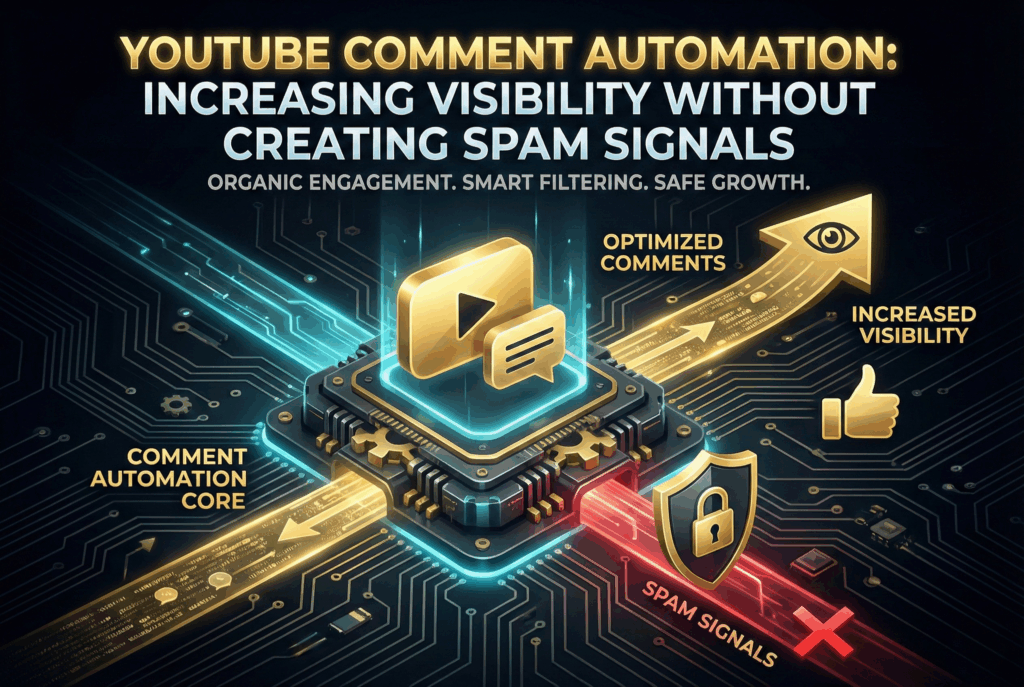
In today’s saturated video ecosystem, publishing high-quality content is no longer enough to guarantee visibility. YouTube’s algorithm evaluates not only watch time and click-through rate, but also the broader interaction landscape surrounding a channel. One of the most underestimated growth levers in this ecosystem is the comment layer. Strategic participation in discussions can dramatically expand brand exposure, increase profile visits, and position an account within high-traffic conversations.
However, scaling this tactic through YouTube comment automation introduces a delicate balance between visibility and risk. While thoughtful automation can amplify reach efficiently, poorly engineered systems often create detectable patterns that trigger YouTube spam signals. When comment structures become repetitive, timing becomes compressed, or engagement depth remains shallow, the platform gradually reduces visibility rather than issuing explicit warnings.
Understanding this distinction is critical.
The challenge is not whether to automate, but how to design automation that aligns with YouTube’s engagement-based ranking system. Visibility on YouTube is built on contextual contribution, behavioral credibility, and sustained interaction quality. Automation that mirrors organic participation patterns strengthens algorithmic trust. Automation that prioritizes volume over variability increases suppression probability.
This article explores how to scale YouTube comment strategy intelligently, focusing on contextual architecture, structural diversification, and adaptive pacing that increases exposure without compromising channel stability.
How YouTube Evaluates Comment Behavior
To understand how to scale YouTube comment automation safely, it is essential to recognize that YouTube does not evaluate comments in isolation. The platform analyzes behavioral context, interaction patterns, and engagement outcomes rather than simply scanning for repeated keywords or duplicate phrases. Comment visibility is influenced by trust modeling that extends across account history, engagement depth, and posting rhythm.
One of the primary elements YouTube evaluates is engagement quality. Comments that generate replies, receive likes from other viewers, and spark extended discussion contribute positively to an account’s credibility signals. In contrast, comments that are ignored, marked as spam, or removed by channel owners weaken YouTube channel trust signals. Over time, repeated low-engagement interactions can reduce the visibility of future comments, even if those comments do not violate any explicit guidelines.
Timing patterns also play a critical role in YouTube spam detection. When comments are posted in tightly compressed time blocks across multiple videos, especially within short operational windows, the system may interpret this as coordinated automation rather than organic viewer participation. Natural user behavior tends to be irregular, shaped by browsing habits and interest shifts. Automated systems that cluster activity for efficiency inadvertently create detectable temporal patterns.
Beyond timing and engagement, YouTube evaluates contextual relevance. Comments that directly reference video content, timestamps, or specific arguments are more likely to be surfaced and engaged with. Generic praise, repetitive compliments, or loosely related promotional statements signal lower value contribution. When automation prioritizes output volume over contextual depth, engagement quality declines and spam probability increases.
Structural repetition is another important factor. Even if comments are not identical, repeating similar sentence cadence, promotional framing, or call-to-action positioning across many videos can create measurable similarity. YouTube’s evaluation systems consider behavioral consistency across an account’s activity history. If comment architecture remains rigidly uniform, linguistic fingerprint density increases.
Account-level behavior further influences comment visibility. Profiles that only post outbound comments without interacting with replies or engaging elsewhere on the platform appear transactional. In contrast, accounts that maintain balanced participation—replying to responses, liking comments, and contributing organically to discussions—reinforce authenticity signals within YouTube’s ranking models.
It is also important to consider cumulative impact. A single low-value comment rarely triggers suppression. However, repeated patterns of shallow engagement, compressed timing, and structural repetition compound over time. As these signals accumulate, YouTube may reduce comment visibility gradually, making future interactions less likely to surface prominently.
In scalable YouTube automation strategies, understanding how comment behavior is evaluated shifts the focus from message frequency to interaction credibility. Safe growth depends on distributing activity naturally, maintaining contextual relevance, diversifying comment structure, and ensuring that engagement outcomes remain positive.
YouTube does not simply measure what is written.
It measures how comments behave within the ecosystem over time.
The Risk of Repetitive and Generic Comment Structures
One of the most underestimated risks in scalable YouTube comment automation is not direct duplication of text, but the repeated use of identical structural frameworks that gradually create measurable similarity across large volumes of activity. While individual comments may appear unique at the surface level, repeating the same emotional opening, validation phrasing, and promotional pivot across dozens of videos produces a recognizable behavioral pattern.
YouTube’s systems do not rely solely on keyword matching when evaluating potential spam. Instead, they analyze behavioral consistency, sentence cadence, engagement outcomes, and promotional positioning across an account’s history. If comments repeatedly follow the same escalation logic—beginning with praise, transitioning into authority positioning, and ending with subtle self-promotion—this structural repetition increases YouTube spam signal probability, even when vocabulary varies.
Generic engagement further amplifies this risk because comments that lack contextual relevance tend to generate minimal replies or meaningful interaction. When low-value comments are posted frequently, the resulting weak engagement depth negatively influences YouTube engagement signals, which can gradually reduce comment visibility in ranking layers. Over time, repeated low-response interactions lower algorithmic confidence in the account’s contribution quality.
Promotional symmetry is particularly sensitive within YouTube’s detection ecosystem. If multiple comments consistently reference external links, suggest visiting another channel, or use similar call-to-action positioning, the platform may assign higher promotional intent probability. The more frequently this structure appears, the stronger the association becomes, increasing the likelihood of reduced comment exposure.
Timing patterns also interact with structural repetition. When comments are posted within tightly compressed time windows and follow similar architectural patterns, temporal alignment reinforces similarity density. At small scale, such overlap may remain statistically insignificant. However, when automation scales across numerous videos or accounts, accumulated structural alignment becomes increasingly visible within YouTube automation detection models.
It is important to recognize that the risk is cumulative rather than immediate. A single repetitive comment rarely triggers suppression, but repeated structural symmetry across an extended activity history gradually increases pattern density. As similarity accumulates, visibility may decline incrementally rather than abruptly, making the issue difficult to diagnose without structural analysis.
Effective scaling therefore requires intentional diversification at the architectural level. Sentence length distribution, emotional tone modulation, engagement intent, and promotional positioning should vary across comment clusters. Contextual references to specific video moments or insights strengthen relevance and reduce spam perception. Timing elasticity further reduces detectable rhythm compression.
In advanced YouTube growth strategies, sustainable visibility depends not only on what is written, but on how consistently the underlying structure evolves. Automation can amplify reach when designed with variability and contextual depth, but when it relies on rigid repetition, it increases detectability over time.
On YouTube, repetition does not merely affect audience perception. It directly influences algorithmic trust.
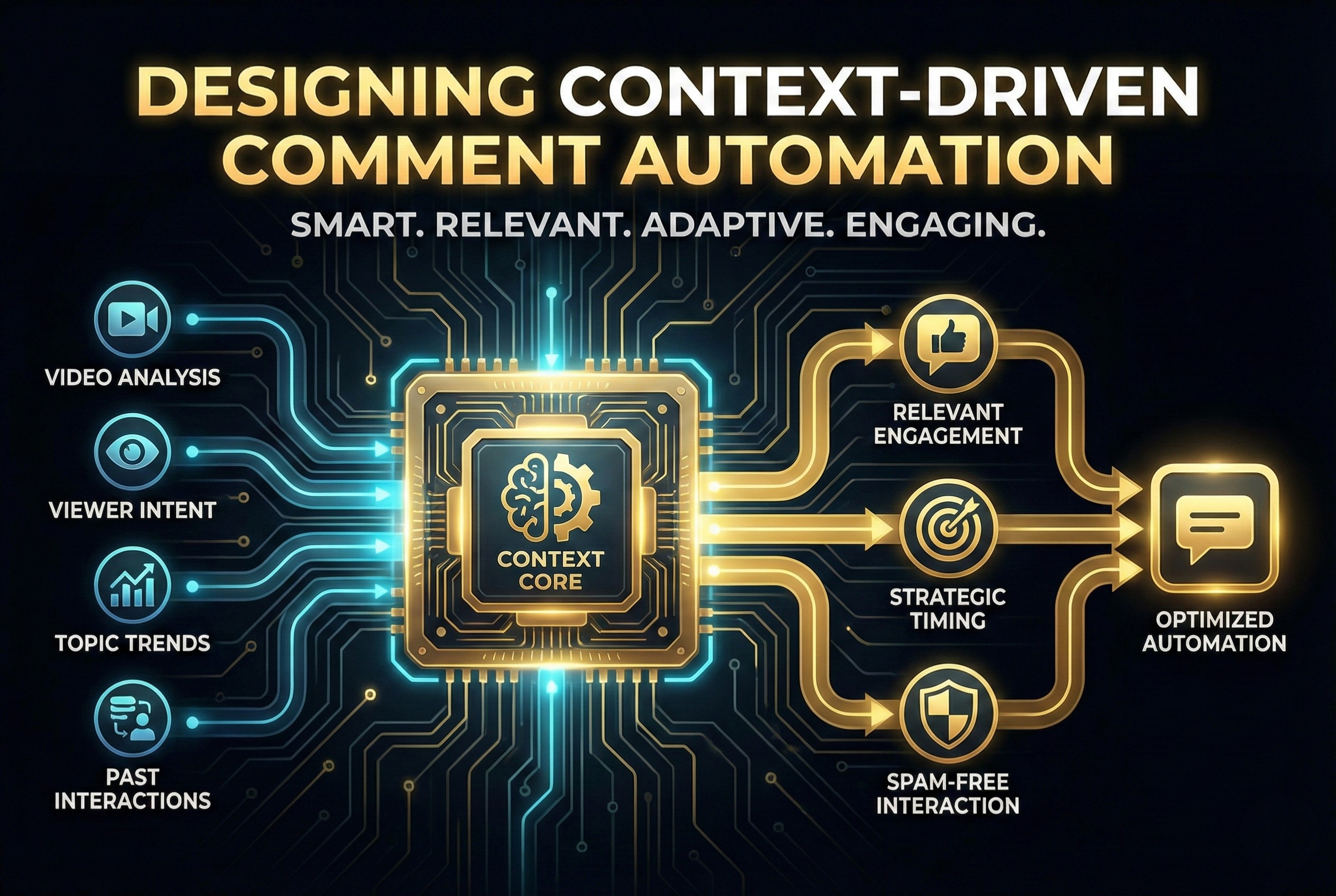
Designing Context-Driven Comment Automation
Effective YouTube comment automation cannot be built around volume alone; it must be anchored in contextual intelligence. The difference between visibility growth and spam suppression often comes down to whether comments genuinely contribute to the conversation or merely occupy space beneath a video. YouTube’s ranking systems prioritize interaction quality and relevance, which means automation must be designed to mirror how real viewers engage with content.
At the core of context-driven comment automation is specificity. Comments that reference a particular argument, timestamp, data point, or example from the video signal authentic consumption. When a comment responds directly to what was said rather than delivering generic praise, it increases the likelihood of replies, likes, and sustained discussion. These engagement outcomes strengthen YouTube engagement signals, which in turn improve comment visibility and account credibility.
Automation systems therefore need to incorporate content-aware inputs rather than static templates. Instead of deploying one adaptable comment framework across all videos, scalable systems should adjust phrasing structure, tone, and intent based on video category, topic, and audience profile. A comment under a technical tutorial should not follow the same emotional cadence as a comment under a motivational vlog. Structural alignment with content context reduces YouTube spam detection risk.
Timing distribution is equally important within contextual design. Comments that appear seconds after a video is published across multiple channels create temporal compression signals. In contrast, activity that reflects natural viewing behavior—distributed across varying time intervals—aligns with organic user patterns. Introducing timing elasticity into automation workflows reduces detectable rhythm consistency.
Intent diversification further strengthens contextual authenticity. Not every comment should attempt to drive traffic or introduce subtle promotion. Some interactions should ask thoughtful questions. Others may expand on a concept introduced in the video. A few may offer constructive counterpoints. This layered variation reduces linguistic fingerprint density and reinforces the perception of genuine participation rather than systematic amplification.
Promotion, when used, must be proportionate and relevant. Context-driven automation prioritizes value before visibility. If a comment adds insight and only occasionally references related content, engagement probability increases. When every interaction includes a call-to-action or channel mention, promotional symmetry becomes detectable and increases suppression risk.
Scalable systems should also incorporate feedback loops. If certain comment types consistently generate replies and likes, those structural patterns can be expanded selectively. If others produce low engagement or are frequently hidden by creators, volume should decrease automatically. Adaptive pacing aligns automation behavior with performance outcomes rather than static quotas.
Another critical dimension of safe YouTube automation strategy is interaction continuity. Posting a comment without responding to replies creates a transactional footprint. When automation includes structured follow-up engagement—such as replying to responses within varied timing windows—it reinforces authenticity signals and increases overall engagement depth.
Ultimately, designing context-driven comment automation requires shifting from template efficiency to behavioral intelligence. Visibility increases when comments feel like natural extensions of the conversation surrounding the video. Suppression risk rises when automation prioritizes repetition over relevance.
On YouTube, contextual depth is not optional.
It is the foundation of sustainable visibility growth.
Scaling Visibility Without Channel Risk
Increasing exposure through YouTube comment automation can be an effective growth lever, but scaling visibility without compromising channel stability requires disciplined architecture. The mistake many operators make is assuming that higher output automatically translates into higher reach. In reality, YouTube’s systems reward sustainable engagement patterns and penalize accumulated structural compression. The objective is not maximum activity, but optimized, low-risk amplification.
To scale safely, automation must align with YouTube’s engagement-based ranking model. Comments that consistently generate replies, likes, and extended discussions contribute positively to overall account credibility. When engagement depth remains strong, visibility expands naturally. However, when posting frequency increases while reply rates decline, the imbalance weakens YouTube channel trust signals, gradually reducing comment exposure.
Performance-responsive pacing is essential.
Instead of setting static daily comment quotas, advanced YouTube growth automation systems adjust output based on engagement outcomes. If comments under a certain category of videos generate high interaction, scaling within that segment is justified. If engagement weakens, activity should contract. Adaptive volume management prevents the accumulation of low-value signals that can elevate spam probability over time.
Timing dispersion also plays a central role in minimizing YouTube spam detection risk. Visibility should scale across distributed time intervals that reflect natural viewing behavior rather than clustered bursts of activity. When comment activity appears synchronized or compressed, it increases pattern density. Introducing irregular timing windows reduces rhythm predictability and reinforces authenticity.
Structural diversification must accompany volume growth.
As comment count increases, maintaining variation in sentence length, emotional tone, and engagement intent becomes even more critical. Scaling identical comment frameworks across numerous videos amplifies linguistic fingerprint density, making automation footprints more visible. Expanding visibility safely requires diversifying architectural patterns alongside output.
Multi-channel operators must be especially cautious about cross-account synchronization. If several accounts comment on the same videos within similar time frames using parallel structural logic, cross-account similarity increases. Distributed timing strategies and differentiated comment styles reduce clustering signals and protect long-term visibility.
Engagement continuity further stabilizes scaling efforts. Accounts that respond to replies, acknowledge feedback, and maintain conversation depth strengthen relational credibility. Automation that includes structured follow-up engagement reinforces organic participation signals and reduces transactional perception.
Sustainable YouTube visibility growth is achieved through balanced expansion rather than aggressive amplification. Gradual scaling aligned with performance metrics, diversified structure, and contextual relevance allows comment-based strategies to enhance channel presence without increasing suppression probability.
In advanced automation environments, risk does not typically arise from a single action. It emerges from accumulated symmetry, compressed timing, and low engagement density across many interactions. By integrating dispersion, adaptability, and contextual intelligence into comment workflows, creators and agencies can expand reach while preserving channel stability.
Visibility grows fastest when trust grows alongside it.
Scaling visibility through YouTube comment automation is not a question of how many comments can be published, but how intelligently they are structured and distributed. YouTube’s systems evaluate cumulative behavioral signals across timing, engagement depth, structural similarity, and promotional positioning. When automation compresses these variables into predictable patterns, YouTube spam detection models gradually reduce comment visibility, often without explicit notification.
Sustainable growth depends on dispersion.
Distributing activity across natural timing windows, diversifying sentence architecture, limiting promotional symmetry, and prioritizing contextual relevance all contribute to stronger YouTube channel trust signals. The goal is to embed automation within authentic interaction patterns rather than layering repetitive structures onto multiple videos.
Performance-responsive scaling further protects channel integrity. When engagement metrics guide volume decisions, automation remains aligned with audience response rather than operating on static output targets. Adaptive systems that expand where interaction depth is strong and contract where it weakens maintain long-term algorithmic credibility.
Ultimately, the comment layer is not merely a visibility shortcut.
It is a behavioral signal generator.
When engineered with contextual intelligence and structural variability, YouTube growth automation becomes a sustainable amplification tool. When engineered around repetition and aggressive promotion, it increases suppression risk.
In advanced multi-platform automation environments, the principle remains consistent: growth is sustainable only when trust scales alongside visibility.
On YouTube, relevance creates exposure.
Repetition creates risk.
Don't stop at reading.
Join the community or pick a plan and start automating today.
Get help, share wins, stay ahead.
Thousands of operators, direct support from the team, and a live feed of updates, tips and drops.
- Live support and troubleshooting from the team and power users
- Setup walkthroughs, targeting tips and workflow templates
- Early word on new bots, features and releases
Ready to put growth on autopilot?
Run your accounts, clients or traffic funnel while Onimator does the work. Start scaling today.
- Unlimited accounts
- All available tasks
- Integrated AI Chatter
- Up to 7 devices