
Mobile vs Residential vs Datacenter Proxies for Instagram Automation

Most operators choose a proxy on price, discover it does not work, and conclude that proxies are a scam. The real problem is usually that they bought the wrong type for what they were doing, or bought the right type in the wrong configuration.
This piece covers the three types, what a platform can actually determine about each, and the configuration mistake that breaks more setups than cheap proxies ever have.
This is the decision layer, not the setup. For the mechanics of getting a proxy onto an Android device, see How to Set Up a Proxy on an Android Device. For how proxies sit alongside VPNs in a full network, see Proxies, VPNs and Onimator.
What a Platform Can Actually See
Before comparing types, it helps to know what is actually being evaluated. An IP address carries more than a location.
Every IP belongs to an ASN, the network that owns it. That tells anyone looking whether the address belongs to a mobile carrier, a home broadband provider, or a hosting company. This is public information, not something clever a platform had to work out.
Alongside that sits reputation: what that address, and the block it lives in, has done before. An address that has been used by many accounts, or by accounts that were removed, carries that history regardless of who is using it now.
You are inheriting a history you cannot see. A brand new account on a recycled address is not a clean slate. This is the single most important thing to understand about buying cheap proxies, and it explains why two people can buy the same product and get completely different results.
Mobile Proxies
A mobile proxy routes through a real mobile carrier, the same network a phone uses on 4G or 5G.
Why they hold up well: carriers use CGNAT, meaning thousands of genuine subscribers share a small pool of public addresses at any moment. A platform cannot treat one mobile IP as one user, because it demonstrably is not. That shared-by-default nature is doing the work, not any cleverness in the proxy.
What they cost: the most of the three, usually by a wide margin, and often sold per port rather than per gigabyte.
Where they fit: accounts that matter. New accounts during warm-up, accounts carrying real revenue, and anything you would be genuinely annoyed to lose.
You do not need mobile for everything. Operators often buy mobile for an entire fleet and run out of budget before they have enough of them. A smaller number of mobile proxies on your most valuable accounts beats spreading yourself thin.
Residential Proxies
A residential proxy routes through a real home internet connection, usually someone who installed an app that resells their bandwidth.
Why they work: the ASN belongs to a consumer ISP, which is exactly what an ordinary user's traffic looks like. Geographic targeting is usually granular, often down to city level.
The catch: the pool is shared, and you have no visibility into who else has used the address you were handed. Quality varies enormously between providers, and the difference is almost entirely about how carefully the pool is managed rather than the technology itself.
Where they fit: the sensible default for most accounts in most fleets. Good balance of cost and behaviour.
Datacenter Proxies
A datacenter proxy comes from a hosting provider. AWS, OVH, Hetzner and similar.
Why they are cheap: they are trivial to produce at scale.
Why that is the problem: the ASN says hosting provider. No ordinary person browses Instagram from a rack in a data centre, and that is knowable from the address alone without any behavioural analysis at all. Entire ranges are well known.
Do not use datacenter proxies for accounts you care about. They can work for a while, particularly on aged accounts with established history, but you are relying on not being looked at rather than on looking normal. They are fine for scraping public data where no login is involved.
Rotating vs Sticky: The Setting That Breaks Setups
This matters more than the type, and it is the thing most guides skip entirely.
Rotating proxies hand you a different IP on every request, or every few minutes. Sticky proxies hold one address for a session, often hours or days.
Rotating sounds safer. It is marketed as safer. For logged-in social accounts it is close to the worst thing you can do.
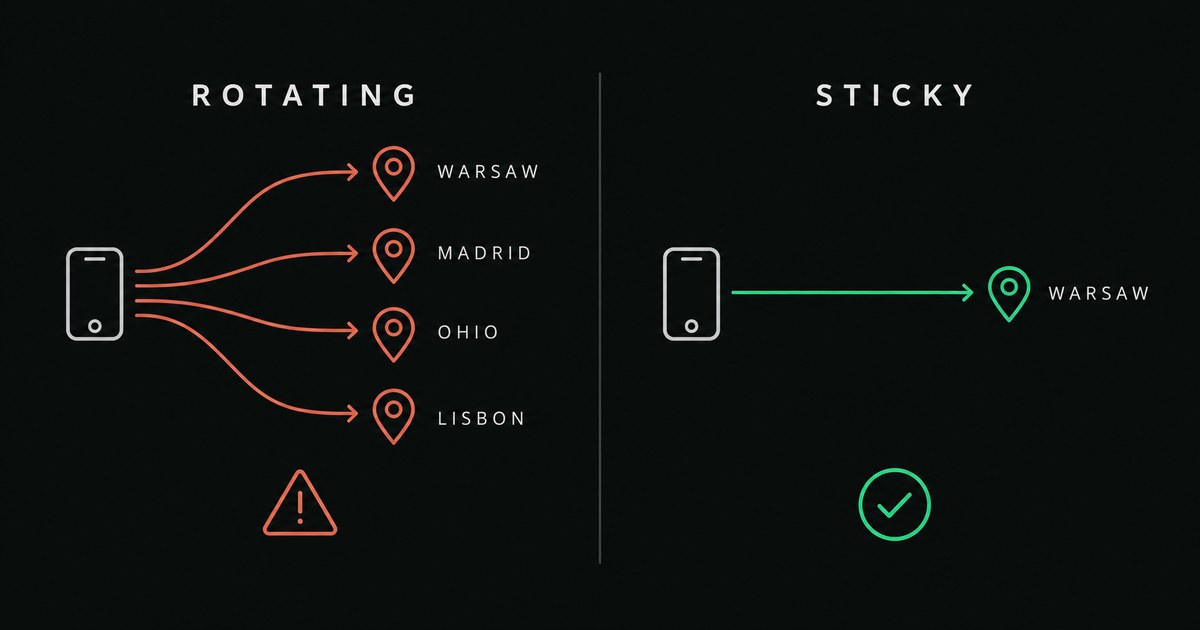
Think about what it looks like from the other side. A user logs in from Warsaw, likes a post from Madrid ninety seconds later, then loads their feed from Ohio. No real person does that. You have not disguised the account, you have made it conspicuous, and you have probably triggered a verification challenge that stops everything.
Use sticky sessions for logged-in automation. One account should present one address, consistently, for as long as possible.
Rotation belongs to scraping, where there is no session and no logged-in identity to keep consistent.
The same reasoning drives the warm-up guidance in the 7-day warm-up sequence. Early sessions establish what normal looks like for that account, and an IP that changes constantly means normal is never established.
One Proxy Per Account
Sharing one proxy across several accounts creates the clearest possible link between them.
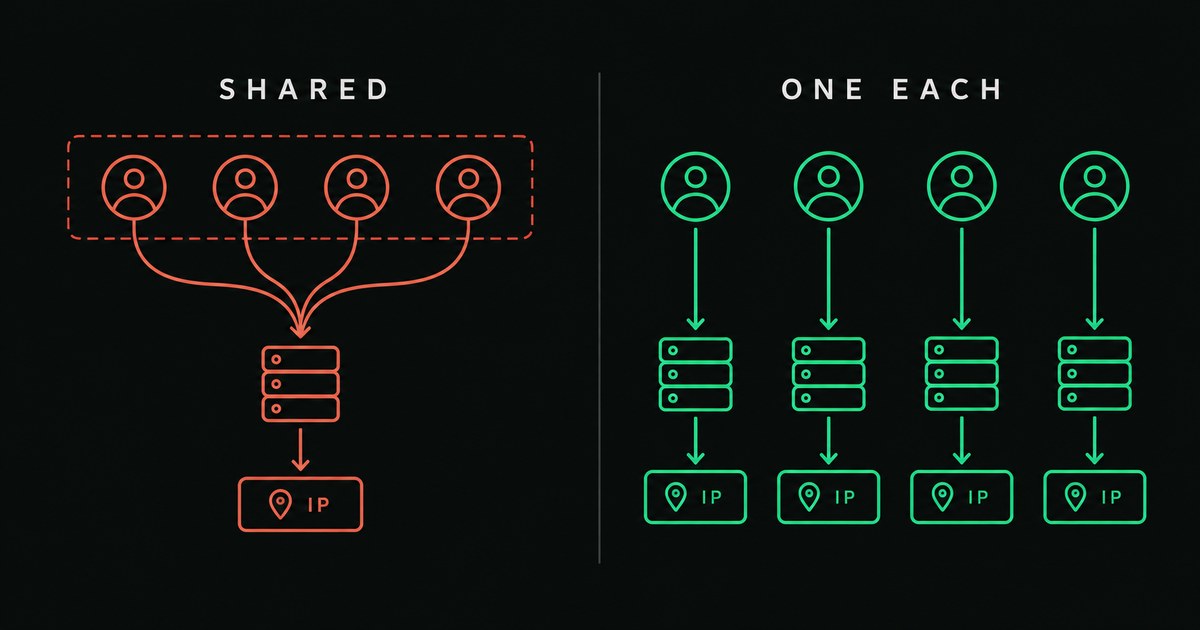
Everything else you do to keep accounts independent, separate devices, staggered schedules, different content, is undone by a shared address. Accounts that log in from the same IP, on the same schedule, behaving the same way, are a set. If one is actioned, the others are trivially findable.
We covered the general version of this in why behavioural correlation is the biggest risk in multi-account automation. The network layer is where it is most visible, because it requires no inference at all.
This is the line worth spending money on. If the budget forces a choice between better proxies and more proxies, more proxies usually wins. Ten residential addresses across ten accounts is a better position than one excellent mobile proxy shared between them.
Geography Has to Agree With Everything Else
An account whose persona is American, whose content is American, and whose IP resolves to Vietnam is telling two different stories.
Worse is changing the story. An account that spent six months on a German address and suddenly appears in Brazil looks like it changed hands, which is exactly what a compromised account looks like.
Pick the country when you create the account, match it to the persona, and stay there.
If you must migrate an account to a new provider, try to stay within the same country and city, and expect a settling period rather than resuming at full pace.
What to Actually Buy
| Mobile | Residential | Datacenter | |
|---|---|---|---|
| Looks like | A phone on a carrier | A home connection | A server |
| Cost | Highest | Middle | Lowest |
| Best for | Warm-up, high-value accounts | Most accounts | Scraping only |
| Shared by design | Yes, thousands of real users | No | No |
A workable structure for a fleet:
Mobile for accounts in their first weeks and for anything carrying real revenue
Residential, sticky, one per account for the bulk of the fleet
Datacenter only for public data collection where nothing logs in
Test before you commit. Buy a small number from any new provider and run them for two weeks on accounts you can afford to lose. Providers vary far more than proxy types do, and the only way to know what a pool has been through is to use it.
Common Mistakes
Buying rotating because it sounded safer. Covered above, and it is the most common single error.
One proxy, many accounts. Saves money, removes the point of separate accounts.
Switching providers mid-life. Every account moves at once, which is itself a correlated event. Migrate in batches over weeks.
Free proxies. Whatever the address has done before, you are inheriting it, and you have no relationship with anyone to complain to.
Treating a VPN as a proxy. A VPN routes an entire device through one tunnel. It cannot give each account its own identity, which is the whole requirement here. See How to Set Up Surfshark VPN for where a VPN genuinely fits.
The Short Version
Type matters, but configuration matters more. A well-configured residential proxy, sticky, one per account, geographically consistent, will outperform a mobile proxy that rotates every ten minutes and is shared between four accounts.
Spend on separation before you spend on quality. The cheapest mistake in this space is buying one excellent proxy. The most expensive one is sharing it.
Don't stop at reading.
Join the community or pick a plan and start automating today.
Get help, share wins, stay ahead.
Thousands of operators, direct support from the team, and a live feed of updates, tips and drops.
- Live support and troubleshooting from the team and power users
- Setup walkthroughs, targeting tips and workflow templates
- Early word on new bots, features and releases
Ready to put growth on autopilot?
Run your accounts, clients or traffic funnel while Onimator does the work. Start scaling today.
- Unlimited accounts
- All available tasks
- Integrated AI Chatter
- Up to 7 devices