
The Silent Killers of Instagram Reach: Zombie vs Ghost Followers

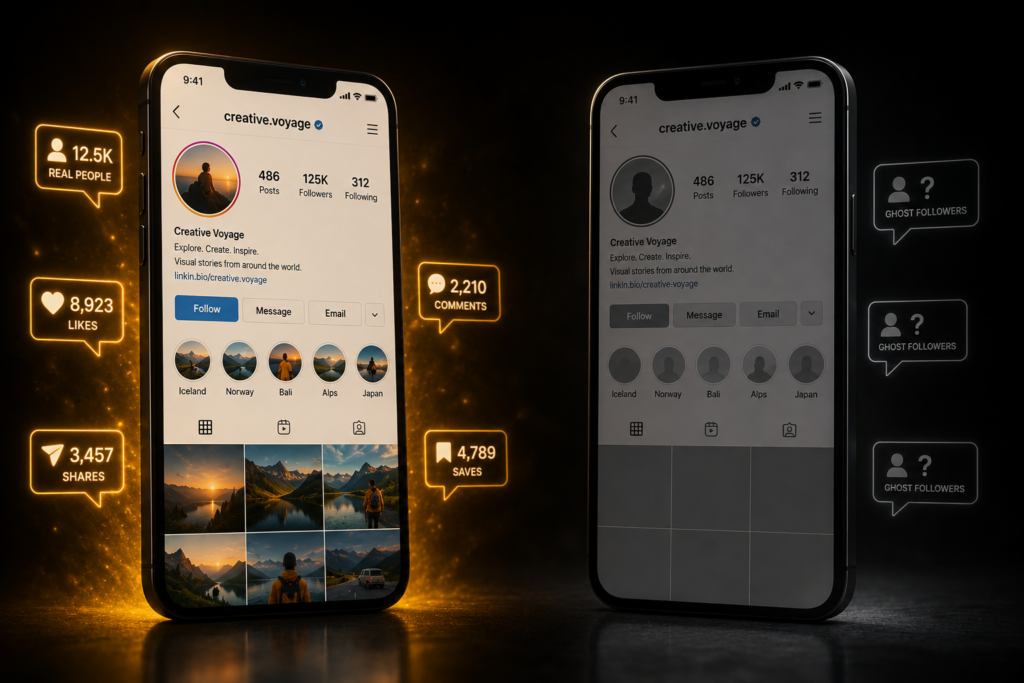
Two Instagram accounts with identical follower counts almost never produce identical reach. The account with 50,000 clean, engaged followers routinely outperforms the account with 50,000 followers that includes 15,000 zombies and 10,000 ghosts, and neither operator can tell from the raw numbers alone what is happening underneath. The follower count says both accounts are the same size. The distribution the algorithm actually delivers says they are nothing alike.
Every serious operator eventually confronts this pattern. Engagement rate drifts down while follower count climbs. Reach on new posts feels tighter than it did last quarter, even though the content is arguably better and the audience is arguably larger. Story views trail behind what the follower count should predict. None of these symptoms have obvious causes, and none of them respond to content improvements, because the underlying problem is not in the content. The problem is in the audience.
Two categories of dead-weight followers cause most of this decay, and they behave differently enough that treating them as one problem produces incomplete solutions. Zombie followers and ghost followers both suppress reach, but through different mechanisms, from different upstream sources, and requiring different responses. Understanding the distinction is what separates operators who fix the problem from operators who chase symptoms.
The follower count is not the audience. The audience is what is left after you subtract the zombies and the ghosts.
The Two Failure Modes
Zombie followers are dead accounts. The person or entity behind the follow no longer exists on the platform in any meaningful sense. They may have abandoned the account, deleted the app, moved to a new account, or, in the case of the many bot accounts that pass through Instagram, been deactivated by the platform without ever removing themselves from the follower lists of accounts they were following. From the follower count’s perspective, they still exist. From the algorithm’s perspective, they contribute nothing.
Ghost followers are alive. Their accounts are active on the platform, they open the app regularly, they scroll their feed, they engage with other creators’ content. The distinguishing feature of a ghost follower is not their absence from the platform. It is their absence from the specific account they are ghosting. They follow the account but never like its posts, never watch its stories, never save its content, and never appear in any of its engagement metrics. From the outside, the follow looks legitimate. From the algorithm’s read of that account, the follow provides zero signal about content quality.
The distinction sounds academic until an operator tries to fix a reach problem. Zombie cleanup and ghost cleanup are different projects with different tools and different outcomes, and conflating them produces solutions that fix half the problem while leaving the other half quietly compounding.
Where Each Comes From
Zombies accumulate through pathways operators can identify in retrospect. Purchased followers, which are almost always low-quality bot accounts from delivery, transition to zombie status quickly once the delivery provider stops maintaining the accounts. Bot networks caught in Instagram enforcement actions become zombies the moment they get deactivated, and remain in the follower lists of every account they were following until manual cleanup or platform-side pruning removes them. Real users who abandoned Instagram entirely, whether from time constraints, platform fatigue, or migration to competing platforms, sit in follower counts for years after their last real interaction.
Ghosts have different upstream causes. Reciprocal follows are the most common source. A user follows the account only because the account followed them, without any real interest in the content, and the reciprocation happens purely as social convention. The follow exists but the engagement intent never did. Viral-post overflow is another common source. A single piece of content goes wide and pulls in followers who liked that specific post but discover the ongoing content does not match what caught their attention, so they stop engaging without unfollowing.
Time also produces ghosts organically. Followers who were engaged when they first followed drift into ghost status as their interests shift, their feed algorithm de-prioritizes the account, or their attention moves to newer creators. Every account carries a baseline ghost rate that accumulates naturally over years of operation, and no strategy prevents it entirely — the best any operator can do is manage the rate at which new ghosts arrive relative to new engaged followers.
How They Actually Hurt You
The mechanism by which both categories suppress reach is the same, and understanding it is what makes the whole framework operational. Instagram distributes new content through a tiered evaluation process. When a post publishes, the algorithm tests it against a small subset of the account’s follower base — usually the most recently active viewers plus a sample of other accounts the algorithm thinks might respond. The response from that initial test audience determines whether the post advances to broader distribution or stays capped at the small sample.
Zombies never see the test. Their accounts do not open the app, do not receive the content, do not produce any signal. When zombies are in the sampled test audience, they contribute nothing to the engagement rate the algorithm measures, and the sample’s overall engagement rate drops as a mathematical consequence. Ghosts do see the test. Their accounts receive the content in feed and stories the same way any active follower does. But they choose not to engage, and their zero-engagement response counts the same as a zombie’s absence — pushing the sample’s engagement rate down.
Both categories hurt through the same downstream mechanism — collapsed initial-test engagement rate — even though the underlying causes differ. And both effects compound. A post that fails its initial test never enters the compounding distribution loop, so the reach ceiling collapses regardless of how good the content is or how well the account’s genuine engaged followers would have responded. The account’s reach rate falls, engagement rate on new content falls in step, and the algorithm learns that this account produces underperforming content and treats subsequent posts with lower confidence.
Ghosts are more insidious than zombies. A zombie’s damage is capped because the account genuinely no longer participates in the platform in any way — once the platform prunes deactivated accounts on its own cleanup cycles, the zombie count often drops without operator action. Ghosts persist. They stay active on the platform indefinitely, keep sitting in follower counts, keep depressing test-audience metrics, and require deliberate operator action to remove.
How to Identify Each

Zombie identification is more mechanical. A random sample of the account’s follower list surfaces zombies quickly through several observable signals. Accounts with no posts in six or more months, accounts with default profile images and no bio, accounts with follower counts of zero or near-zero, and accounts that have not appeared in any story-view lists across dozens of the account’s own stories are almost always zombies. Third-party audience-analysis tools can automate this scan across the whole follower base and produce an estimated zombie percentage.
Ghost identification is harder because ghosts look normal on the surface. The distinguishing test is not what the ghost’s own account looks like — the account may be active, well-maintained, and legitimately engaging with other creators. The test is whether the ghost has engaged with the specific account they are ghosting across any recent posts, stories, or interactions. Accounts that appear nowhere in the last twenty story-view lists, have never liked or commented on a recent post, and have not appeared in any DM history are ghosts relative to that specific account, regardless of how active they are elsewhere.
The practical diagnostic combines both approaches. A sample of the follower list identifies zombies mechanically. Cross-referencing that sample against the account’s own engagement history — story views, likes, comments, saves — identifies which of the remaining accounts are ghosts relative to this specific account. The combined analysis usually reveals that the account’s genuine engaged audience is substantially smaller than the follower count suggests, often 40 to 60 percent of the raw number rather than the 100 percent operators tend to assume.
The Cleanup Strategy
Removing zombies and ghosts requires different judgment calls. Zombie removal is straightforward — the accounts contribute nothing and cannot be reactivated, so removing them is pure algorithmic upside. The mechanical cleanup can move as aggressively as the operator has patience for, using the platform’s built-in “remove follower” function on identified zombie accounts. The one caution is that dramatic follower-count drops can trigger unusual-activity flags on the removing account, so gradual cleanup over weeks is safer than removing thousands in a single session.
Ghost removal is a judgment call. Some ghosts might be reactivated through content that specifically speaks to what drew them originally, and removing them permanently forecloses that possibility. Others are simply never going to engage regardless of content, and removing them improves algorithmic performance the same way removing zombies does. The right threshold is usually somewhere around 60 to 90 days of complete non-engagement — accounts that have not engaged with anything the operator has posted in that window are unlikely to reactivate and are worth removing.
Neither cleanup approach should involve replacing removed followers with purchased ones. Purchased followers are the primary manufactured source of zombies, and using them to inflate follower counts back to pre-cleanup levels replaces the removed dead-weight with new dead-weight, undoing the cleanup effect entirely. The point of the cleanup is not to maintain the follower number. The point is to improve the ratio of active engaged followers to total followers, and that ratio can only improve by removing dead weight without adding new dead weight to replace it.
Why Prevention Beats Cleanup
The most efficient strategy is not producing zombies and ghosts in the first place. Every follower acquisition strategy either generates dead-weight followers or minimizes them, and the strategy determines the ratio the account will eventually reach.
Follow-for-follow strategies produce both zombies and ghosts at high rates. The reciprocity that drives the growth also drives the future ghost problem, because followers who reciprocated purely to be reciprocated back have no engagement intent from the start. Purchased followers produce zombies exclusively, and produce them faster than any legitimate strategy could match. Viral one-hit content produces followers who are ghosts within weeks because the content that pulled them in does not match the account’s ongoing production.
Quality source-account targeting produces the lowest zombie-and-ghost rate. Following the followers of accounts whose audience genuinely overlaps with what the account produces means the resulting follow-backs come from users who care about the content, and those users are far more likely to remain engaged over time than followers acquired from loosely-related sources. The follow-back ratio from quality sources is often lower than from broad sources, but the long-term engaged-follower yield is dramatically higher.
Operators who evaluate source quality only on follow-back rate miss the ghost problem entirely. Follow-back rate measures whether the follow-back happened. Ghost rate measures whether the follower stays engaged three months later. Two sources can produce identical follow-back rates and wildly different ghost rates, and only the latter matters for long-term account performance.
The cleanup fixes the follower base you have. Source quality determines the follower base you will have next year.
Don't stop at reading.
Join the community or pick a plan and start automating today.
Get help, share wins, stay ahead.
Thousands of operators, direct support from the team, and a live feed of updates, tips and drops.
- Live support and troubleshooting from the team and power users
- Setup walkthroughs, targeting tips and workflow templates
- Early word on new bots, features and releases
Ready to put growth on autopilot?
Run your accounts, clients or traffic funnel while Onimator does the work. Start scaling today.
- Unlimited accounts
- All available tasks
- Integrated AI Chatter
- Up to 7 devices