
The Source Depletion Trap: Why Your Automation Silently Loses Steam After 3 Months


An operator sets up an account, configures well-chosen sources, dials in reasonable action limits, and lets the automation run. For the first few weeks the output is steady. Follow-backs come in at expected rates, engagement holds, and the account grows on the trajectory the operator planned for. By month three, something has shifted. Daily action counters are lower than they used to be. Follow-back rates are down. Engagement is thinner. Nothing in the configuration has changed, but the numbers keep drifting adverse.
The natural assumption is that the platform has tightened detection and the account is now facing scrutiny it did not face at the start. So the operator tightens the automation further — reduces action limits, adds cooldown windows, extends rest periods between sessions. The output drops further. The cycle continues until the operator either abandons the account or spends weeks investigating a detection problem that is not actually there.
The real problem, in most cases, is neither the configuration nor the platform’s scrutiny. It is that the source accounts the automation has been drawing from have been silently depleted. The account has already engaged most of the usable candidates in those sources, and each subsequent pass produces fewer new targets than the pass before. The automation is doing exactly what it was configured to do. The source layer underneath has quietly stopped feeding it enough candidates to sustain the original output.
The automation did not slow down. The pool it was drawing from ran dry.
What Actually Happens to Sources Over Time
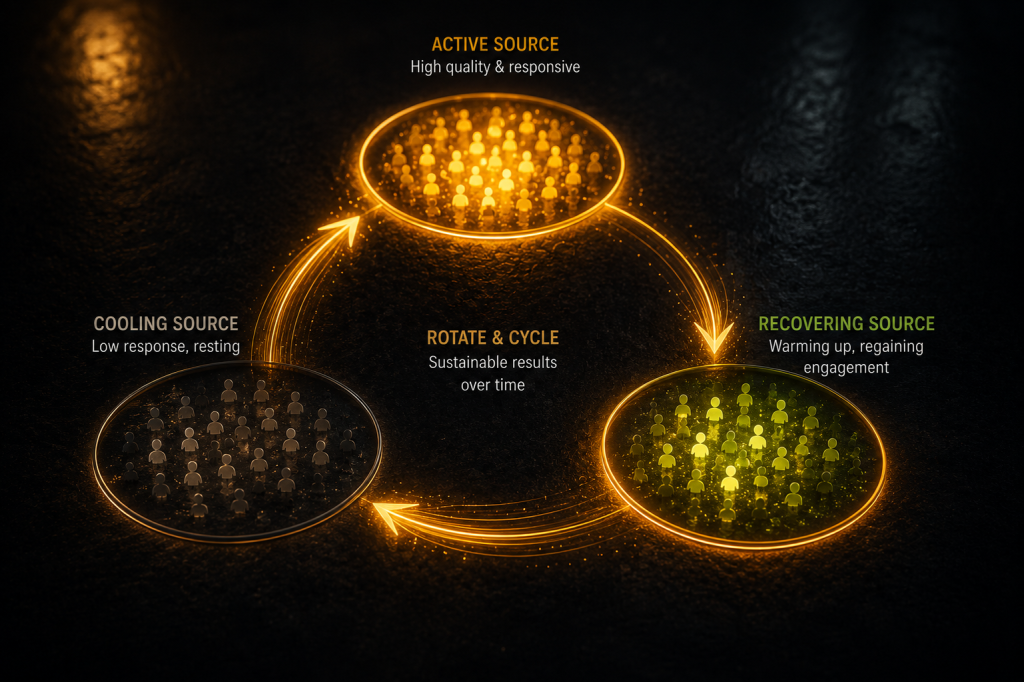
Every serious automation platform runs some form of lifetime dedup — a mechanism that prevents the account from ever visiting the same target twice across its entire operational history. This is a safety feature, and it is correct. Accounts that repeatedly hit the same targets produce a pattern platforms flag as spammy, and lifetime dedup is what prevents the pattern from ever developing.
The side effect is that every source becomes less useful with every pass. The first time the automation works through a source’s follower list, the candidate pool is fresh — dedup has nothing to filter, and the campaign gets full exposure to everyone the source produces. The second pass through the same source produces a substantially smaller usable pool because the previously-engaged candidates get filtered out. By the fifth or tenth pass, the same source produces almost nothing usable, because nearly everyone in its follower base has already been engaged.
The rate at which this depletion happens depends on the specific source. A source with a large, actively-churning follower base takes longer to deplete because new followers keep arriving and refreshing the pool. A source with a stable follower base depletes faster because there is no natural refresh — every pass filters out more of the same fixed pool. Most sources sit somewhere in the middle, producing meaningful output for weeks before starting to underperform, then declining more steeply as the accumulated dedup exceeds the natural refresh rate.
The critical operational reality is that this depletion is invisible in the automation’s activity dashboard. The bot keeps running, the source list keeps being referenced, actions keep being dispatched. What changes is how many of those dispatched actions actually land on new candidates versus getting silently filtered out by dedup. From the operator’s perspective, output declines. From the tool’s perspective, the campaigns are running exactly as configured.
Why the Decline Feels Like Detection
The symptoms of source depletion look strikingly similar to the symptoms of platform detection, which is why the misdiagnosis is so common. Output declines. Follow-back rates drop because the diminishing pool of new candidates is often lower quality than the original pool was. Follower growth rate falls. Engagement thins. All of these are also the classic markers of an account that has slipped into elevated platform scrutiny, and operators who have seen detection scenarios in the past pattern-match to detection first.
The tightening response makes the depletion worse rather than better. Reducing action limits means the automation makes fewer attempts against the depleted source pool, which produces even lower absolute output. Extending cooldown windows spaces out the same reduced output across a longer time, making it look like the account has genuinely gone quiet. Investigating for detection burns weeks the operator could have spent on the actual fix, which is refreshing the source layer rather than throttling the automation layer.
Some operators eventually cycle back and try scaling automation up again, at which point they briefly recover some output — until the fresh action volume exhausts the marginal candidates the previous throttling had preserved, and the decline resumes on the new baseline. The cycle can go on for months before anyone thinks to check whether the sources themselves are actually still producing.
The Source Health Score Framework
Diagnosing source depletion properly requires looking at sources through more than just their immediate follow-back rate. The source health score is a composite metric that combines several signals into a single indicator of whether a specific source is still worth pulling candidates from.
Follow-back rate is the immediate conversion signal — the percentage of targets from this source that reciprocated the follow within a defined window. Higher is better, but it only tells the operator whether the initial action worked. It says nothing about whether the follower stays engaged over time.
Retention rate measures how many of the source’s acquired followers remain in the account’s follower list after 30, 60, or 90 days. Sources that produce high initial follow-back rates but whose acquired followers unfollow within weeks are producing shallow growth. Sources whose acquired followers stay for months are producing genuine audience.
Engagement quality measures whether the acquired followers actually interact with the account’s content over time. Followers who never engage — future ghost followers — depress the account’s engagement rate even when follow-back numbers look strong. Followers who engage authentically build the account’s long-term health across every downstream metric.
Depletion state measures how much of the source’s follower base the account has already engaged through lifetime dedup. Even the highest-quality source in the fleet eventually depletes to zero effective candidates if it is worked hard enough for long enough. Depletion is what turns a great source into a dead source over time.
Operators evaluating source performance through this composite framework catch depletion early. Sources that are still producing strong retention and engagement but showing depletion drop-off get moved to rest states before their output collapses. Sources with weak retention regardless of follow-back rate get retired before more effort is sunk into them. Sources that are performing across all dimensions get scaled up further.
Rotation Strategies That Actually Work
The operational answer to source depletion is source rotation — systematically cycling through different sources so no single source gets worked to exhaustion, while depleted sources rest and refresh before returning to active use.
Round-robin rotation is the simplest starting point. The operator maintains a broader pool of sources than any single campaign uses, and each campaign draws from a subset of the pool. After a defined active window, sources move to a rest state, and fresh ones from the pool take their place. This produces predictable rotation but does not respond to source performance — high-performing sources rest the same as low-performing ones, and the operator misses opportunities to lean into what works.
Performance-weighted rotation adjusts active time based on outcomes. Sources with strong health scores stay active longer and return from rest faster. Underperforming sources move to rest sooner and stay there longer. This produces better aggregate output but requires the automation platform to track per-source performance metrics and expose them to the rotation logic.
Freshness-weighted rotation prioritizes sources whose target pools have visibly shifted since the last active period. Sources whose follower base has churned substantially get preferred over sources whose follower base has stayed static. This produces the strongest candidate diversity but requires the platform to detect source churn programmatically, which is not universally implemented.
The right rotation strategy depends on the operator’s scale and tooling. Solo operators managing a handful of accounts can often get by with round-robin plus manual health checks. Agencies running dozens of accounts across many niches need performance-weighted rotation or better, because manual source management at scale is impractical. Fleet-scale operations often layer freshness-weighting on top of performance-weighting to squeeze the last increment of output from a limited source pool.
When to Retire Sources vs Rest Them
Not every underperforming source is worth resting for eventual return. Some sources come back after rest with meaningfully refreshed candidate pools. Others do not. Distinguishing the two prevents operators from spending effort resting sources that will never usefully return.
Sources worth resting are ones whose follower base has demonstrated churn during the active window — new followers arriving, old followers leaving, the underlying pool visibly shifting even as the source stays consistent. These sources refresh naturally during rest periods and often produce strong output when they return to active rotation weeks or months later.
Sources worth retiring are ones whose follower base has stayed static during the active window. If the source produced no meaningful churn during the weeks it was active, resting it for weeks or months will not produce churn either. The source is simply not gaining new followers who could later become fresh candidates, and returning it to rotation just repeats the depletion cycle against the same pool the account has already exhausted.
Live-check verification also matters at the retirement decision. Sources whose current status has changed since they were added — accounts that got restricted, went private, or were deleted — should be retired regardless of their previous performance, because the source no longer produces usable candidates at all. Operators who never run live-check often keep dead sources in rotation for months, wasting campaign slots that could go to sources still capable of producing output.
Why This Matters for Long-Term Operations
Source management is the invisible operational discipline that separates automation strategies that sustain output over years from strategies that produce strong output for three months and then quietly decline. Operators who treat source lists as configure-once assets discover their fleets producing less every quarter without any obvious cause. Operators who treat source lists as continuously-managed pools — rotating actively, tracking health scores, retiring dead sources, adding fresh ones — produce fleets that compound output across the whole operational lifetime.
The other consequence of proper source management is that operators stop misdiagnosing depletion as detection. When the actual cause of output decline is source exhaustion rather than platform scrutiny, the fix is refreshing the source layer, not throttling the automation layer. Recognizing this early saves weeks of wasted investigation and prevents the counterproductive tightening cycles that dig operators deeper into the exact problem they thought they were solving.
Automation runs on candidates. When the candidate supply runs dry, the automation runs dry. Everything else is downstream of that.
Don't stop at reading.
Join the community or pick a plan and start automating today.
Get help, share wins, stay ahead.
Thousands of operators, direct support from the team, and a live feed of updates, tips and drops.
- Live support and troubleshooting from the team and power users
- Setup walkthroughs, targeting tips and workflow templates
- Early word on new bots, features and releases
Ready to put growth on autopilot?
Run your accounts, clients or traffic funnel while Onimator does the work. Start scaling today.
- Unlimited accounts
- All available tasks
- Integrated AI Chatter
- Up to 7 devices