
Why Your Snapchat DMs Aren’t Landing — The Acceptance Bottleneck
An operator runs a Snapchat growth strategy that generates high inbound friend-add volume. The setup works — profile promotion produces adds, cross-platform funnel drives adds, coordinated add campaigns from supporting accounts fill the inbound queue. Every day the account picks up dozens of new friend requests from users who saw the profile and wanted to connect. The strategy is producing exactly what it was designed to produce.
Then the operator checks reply rates on outbound DMs and finds they’ve collapsed. Messages that should be reaching real users interested enough to add the account are getting no responses. The outbound automation is dispatching cleanly, the personas are on-point, and the content is the same content that worked six months ago. But the conversion has quietly died.
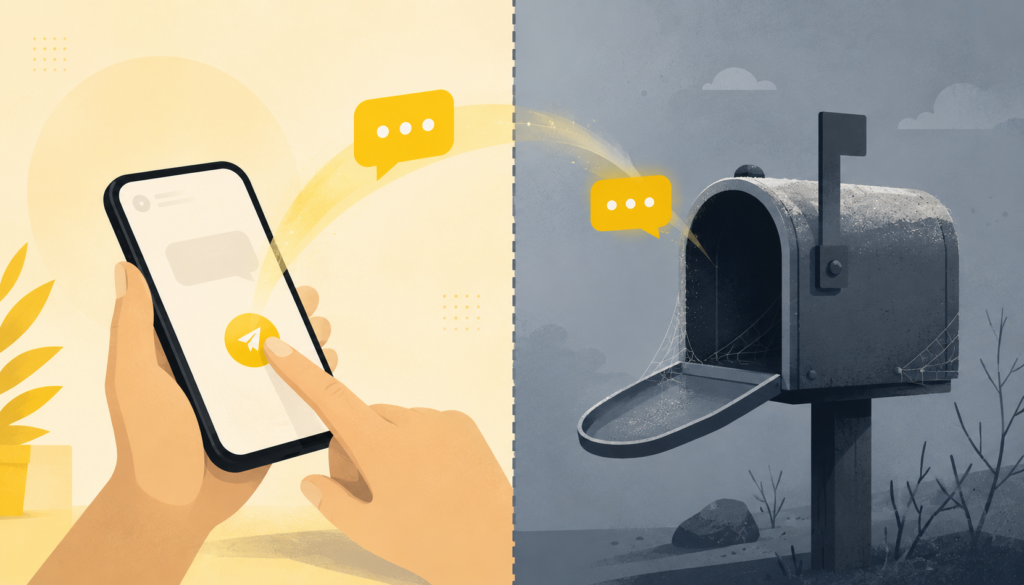
The account is not shadowbanned. The messages are not filtered. The problem is that most of the DMs are being sent to users who never actually became friends with the account — they added the account, and the account never accepted them back. On Snapchat’s specific friend model, that gap is not a rounding error. It’s the difference between a message that lands in the recipient’s inbox and a message that doesn’t deliver at all.
The Snapchat friend model is asymmetric in a way that makes acceptance a load-bearing operational bottleneck most operators discover only after their inbound conversion has already collapsed.
What Snapchat’s Friend Model Actually Does
Snapchat’s friend system is not symmetric like Instagram follows or Reddit chat requests. On Snapchat, anyone can add anyone unilaterally — the add doesn’t require the target’s approval to complete. Type a username, scan a Snapcode, or tap Add from the Quick Adds panel, and the friend request goes through immediately. From the requester’s side, the account has been added; from the target’s side, a pending request has arrived in the Added Me tab.
Nothing about this pending state enables message delivery. Snaps and Chats sent from the requester to a target that hasn’t accepted don’t reach the target’s main inbox. Depending on the specific relationship state, they either don’t deliver at all, deliver in a degraded state marked as pending, or appear in a filtered queue the target rarely checks. The result is functionally the same: the intended audience doesn’t see the message, and the strategy that depended on message delivery produces no measurable conversion.
Acceptance is the specific action that converts the friend relationship from one-way to mutual. Once the target accepts, message delivery works in both directions. Snaps and Chats reach the recipient’s main inbox with the usual notifications. Response rates normalize to what the content and persona quality actually justify. Every friend request that gets accepted unlocks the full communication channel; every request that doesn’t sits in the pending queue producing zero operational value.
The Silent Failure Mode
The failure mode is silent because the outbound automation doesn’t know anything went wrong. From the outbound side, the DMs get sent. The Snapchat interface shows them as delivered from the sender’s perspective. The automation logs the actions as successful. No error is thrown, no popup appears, no visible signal indicates that the messages are landing in a state where the recipient will never read them.
The only visible symptom is the collapsed DM reply rate, which the operator typically attributes to the wrong cause. Common wrong attributions include: content quality decline (the same content that worked before), persona drift (the personas haven’t changed), platform enforcement (there’s no throttling), audience saturation (the inbound is fresh, not saturated). None of these explain the drop because none of them are the actual cause. The actual cause is that the majority of the outbound recipients aren’t friends with the account and never were.
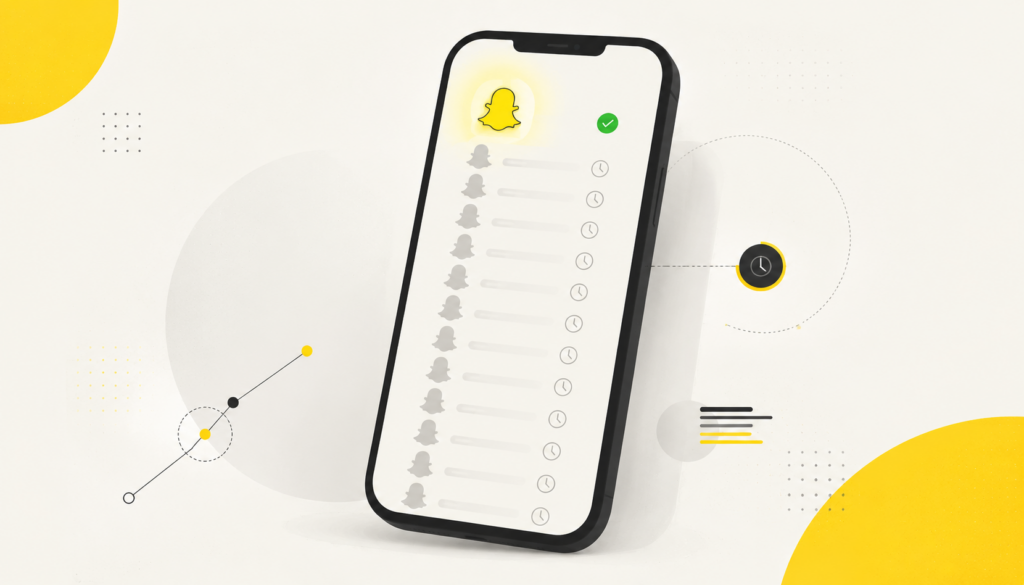
Operators typically only diagnose this after weeks or months of degraded performance. They check the Added Me tab expecting to find a few pending requests and find hundreds or thousands accumulated over the period. Every request in that queue represents an inbound user who wanted to connect and whose account has been sitting in an unresolvable state because nobody on the operator’s side ever accepted them.
Why Manual Acceptance Doesn’t Scale
The obvious response to discovering the pending queue is to sit down and accept everything manually. This works once — the operator processes the backlog over an afternoon, dispatches DMs to the newly-accepted friends, and reply rates recover briefly. Then the backlog rebuilds within days as new inbound continues arriving faster than the operator can process it, and the acceptance gap reopens.
The specific problem is throughput. An account with strong inbound flow generates dozens to hundreds of new requests per day. Processing each request — opening the Added Me tab, reviewing the requester’s profile, deciding whether to accept, tapping accept — takes seconds per request in aggregate, but at hundreds of requests per day across multiple accounts, the daily time cost exceeds what any operator can sustain alongside the actual creative and strategic work the operation requires.
Operators facing this typically either accept the backlog cost (and watch reply rates cycle between recovery and collapse as the backlog rebuilds), reduce inbound flow to what manual acceptance can process (which caps the strategy at a fraction of what the inbound side could produce), or automate the acceptance layer.
What Acceptance Automation Actually Does

The Accept Friends automation processes the pending request queue on a defined schedule based on configurable acceptance criteria. On its scheduled runs, the automation opens the target account’s Snapchat, navigates to the Added Me tab, and accepts requests that match the configured rules. Requests that fail the criteria get ignored, blocked, or reported based on operator preference.
The operational effect is that the acceptance layer runs in the background at whatever volume the inbound produces, without requiring per-request operator attention. New inbound requests get processed within hours instead of accumulating in a queue for weeks. The friend relationships that unlock message delivery get established at the pace the inbound arrives, which restores the outbound DM campaign automation to the effective conversion rate the strategy was designed to produce.
Acceptance criteria vary by strategy. The simplest configuration accepts all incoming requests — appropriate for open-inbound strategies where any accept has potential operational value. More selective configurations filter based on requester profile signals: display name patterns, bitmoji presence, mutual-friend count, or profile completeness. Broader acceptance produces higher accept volume with more spam intake; narrower acceptance produces lower accept volume with higher signal quality.
The Pacing Problem
Acceptance automation that accepts every pending request within seconds of arrival produces a detection signature that Snapchat treats as automated. Real users don’t process their Added Me tab in real-time — they open the app periodically, notice pending requests, accept some, ignore others, and close the app. The specific temporal pattern real users produce is bursty and distributed, not steady-state processing of every request within moments of arrival.
Well-configured acceptance automation distributes acceptance across the day rather than clustering it at a single session, introduces natural variation between individual accept actions, and occasionally skips requests entirely to produce the specific inconsistency real users produce. Daily volume caps prevent the account from producing accept volume that exceeds what a real user with strong inbound flow would produce naturally. This is the specific behavioral baseline Snapchat’s detection systems expect from ordinary users with active social graphs.
The specific configuration values that produce sustainable output differ from what operators intuitively want to set. Aggressive acceptance rates (every request accepted within minutes) produce faster queue processing but generate the mechanical signature Snapchat’s detection systems watch for. Conservative rates (multiple sessions per day with realistic gaps) produce slower queue processing that keeps up with normal inbound flow without generating the automation signature.
The Coordination Problem
Acceptance automation running in isolation on an account still produces the specific temporal pattern where accepts happen at defined intervals matching the automation schedule. If the automation runs twice per day at fixed times, the account produces two acceptance sessions per day at those times, which reads as scheduled rather than as ordinary browsing behavior.
Coordinating acceptance timing with other running Snapchat automation on the account — outbound adds, DM dispatch, story views — produces the aggregate activity pattern that reads as one user opening the app to do various things during natural browsing sessions. This coordination happens at the anti-detection layer rather than being configurable per-tool: the specific timing of each automation gets distributed across natural browsing hours by the platform’s scheduling layer, and the aggregate produces a session pattern that matches what a real user’s Snapchat usage looks like.
Onimator’s Timer tab handles this coordination without requiring per-tool operator configuration. The operator sets the acceptance rate and daily volume, and the platform distributes the actual acceptance sessions in coordination with the other running Snapchat tools so the account’s activity pattern reads as natural. Underneath, the task queue interleaves acceptance actions with the account’s other scheduled activity so no single tool’s cadence becomes visible as its own signature.
The Recovery Math
Accounts that have accumulated pending queue backlog can recover once acceptance automation gets enabled, but the recovery isn’t instant. The backlog processes at whatever rate the acceptance configuration produces, which typically means days to weeks to clear multi-hundred-request backlogs at safe volumes. During the recovery window, reply rates gradually improve as the previously-pending users transition to friend state and become reachable for outbound DMs.
The math after recovery is straightforward: reply rates return to what the content and persona quality actually justify, which is typically materially higher than the pre-fix state because the collapsed reply rate was averaged across a large denominator of undeliverable messages. Once the majority of outbound goes to actual friends, the aggregate reply rate reflects real audience response rather than being suppressed by the delivery failure.
Long-term, the specific difference between accounts that maintain acceptance automation and accounts that don’t is measured in the effective conversion rate of the inbound side of the strategy. Accounts with automation convert inbound at close to the theoretical maximum — every request that meets acceptance criteria becomes a friend, every friend is reachable via outbound DM, every DM lands in the recipient’s inbox. This is the specific DM deliverability ceiling the strategy was designed to operate against. Accounts without automation lose the majority of inbound conversion to the acceptance gap regardless of how well every other component of the strategy performs.
Where This Fits in the Snapchat Stack
Acceptance automation is one of the specific tools that closes the gap between what Snapchat’s friend model requires and what manual operator throughput can sustain. Without it, high-inbound strategies collapse under the acceptance bottleneck regardless of how well the outbound side performs. With it, the inbound and outbound sides operate at proportional throughput and the aggregate produces the operational output the strategy was designed to generate.
The specific configuration that closes the gap — acceptance criteria matched to the strategy’s inbound quality profile, pacing that reads as natural user behavior, coordination with other running Snapchat automation — takes minutes to set up. The specific configuration that leaves the gap open requires no setup at all, which is why it’s the default state for operators who don’t know to look for it.
Snapchat’s friend model requires acceptance to unlock delivery. High-inbound strategies produce more acceptance workload than manual processing can sustain. Without automation, the majority of inbound conversion silently dies in the pending queue. With it, the operation runs at the effective rate the strategy was designed for. The tool takes minutes to configure. The gap it closes is the difference between operational output and collapsed reply rates.
Don't stop at reading.
Join the community or pick a plan and start automating today.
Get help, share wins, stay ahead.
Thousands of operators, direct support from the team, and a live feed of updates, tips and drops.
- Live support and troubleshooting from the team and power users
- Setup walkthroughs, targeting tips and workflow templates
- Early word on new bots, features and releases
Ready to put growth on autopilot?
Run your accounts, clients or traffic funnel while Onimator does the work. Start scaling today.
- Unlimited accounts
- All available tasks
- Integrated AI Chatter
- Up to 7 devices