
Should You Buy Aged Instagram Accounts or Create Your Own?

Every operator scaling past a handful of accounts reaches the same fork. Creating accounts is slow and the first month is fragile. Buying them looks like paying to skip that month.
The pitch is straightforward: a two-year-old account with real followers and posting history behaves better than something registered yesterday. That part is true, and our own numbers support it. An aged account with clean history sustains meaningfully higher volume than a new one.
But the thing being sold is rarely the thing being bought, and the gap between them is where the money goes.
This is the acquisition decision, not the warm-up process. For getting any account, bought or created, safely into production, see How to Warm Up a New Instagram Account.
Age Is Not the Asset
The word "aged" does a lot of work in these listings, and it points at the wrong thing.
A registration date is a number in a database. What actually matters is what happened between that date and today: continuous sessions from consistent devices, activity that rose and fell like a person's, engagement that was received as well as given, and a long period of nothing going wrong.
That accumulated record is the asset. Age is just how long it had to accumulate.
A dormant account has age without history. An account registered in 2023 that posted for two months and then sat untouched has a registration date and almost nothing else. Our own warm-up guidance treats this case explicitly: an aged account with no recent activity still needs seven to fourteen days of warm-up, because the inactivity gap creates a behavioural discontinuity. The age did not remove the problem, it just changed its shape.
The account that is genuinely worth having is the one that never stopped. Those are rarely the ones for sale.
You Are Buying a History You Cannot See
This is the same trap as buying cheap proxies, and it fails for the same reason.
When you take over an account you inherit everything it did before you. Every action block it collected. Every appeal it filed. Every device it logged in from, every IP it used, every other account those devices and IPs also ran. If it sat in a batch of five hundred created by the same seller on the same infrastructure, it is correlated with all of them, and nothing in the listing mentions that.
We wrote about the network version of this in the proxy comparison, where a recycled IP carries a history you cannot inspect. Accounts work the same way, except the history is longer and the price is higher.

What you can check: follower count, post history, engagement rate on visible posts, whether the bio and content look coherent.
What you cannot check: prior restrictions, prior appeals, what else ran on the same devices, whether the followers were bought, whether the account has been sold before, and how many times.
The Risk Nobody Prices In
An account you bought can be taken back.
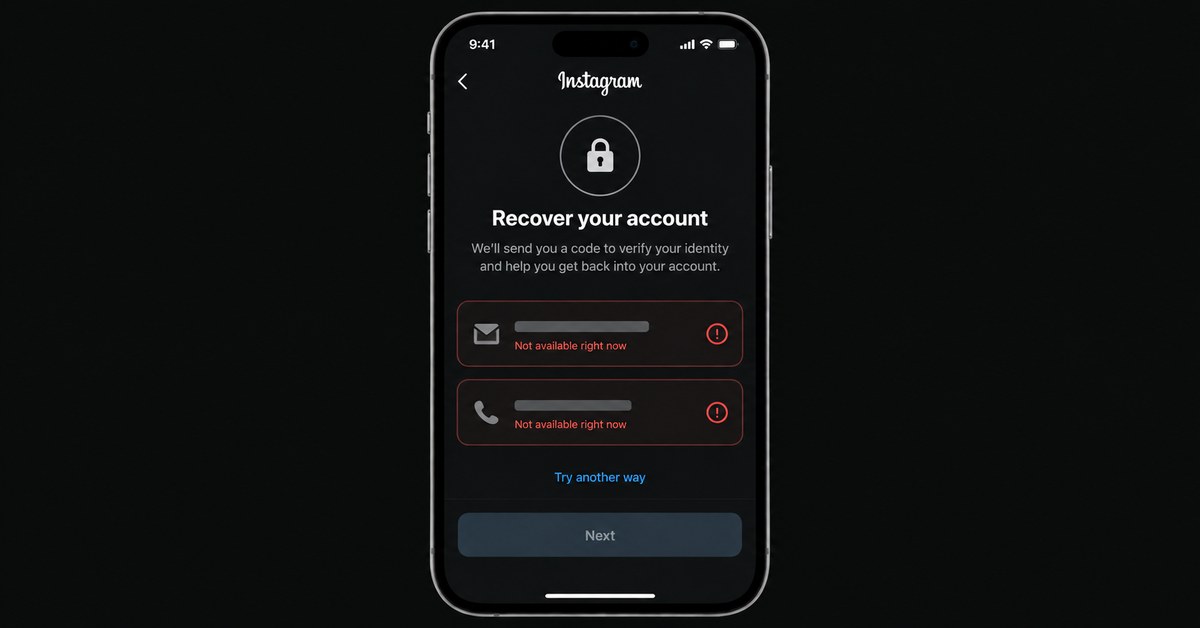
Whoever created it knows the original email, the original phone number, and the answers to the recovery questions. Recovery flows exist precisely so that a genuine owner can reclaim an account from someone who has the password. From the platform's side, you look like the intruder.
This is not theoretical and it is not rare. It usually happens after you have spent weeks warming the account and pointing traffic at it, which is exactly when it is worth taking back.

Change everything immediately or do not buy at all. Email, password, phone, recovery options, and 2FA, on day one. If the seller will not release the original email, you are not buying an account, you are renting one from somebody who can end the lease.
The Honest Comparison
| Created yourself | Bought | |
|---|---|---|
| Cost | Time, roughly a month per account | Money, immediately |
| History | Known, because you made it | Unknown, always |
| Recovery risk | None | Real, and permanent |
| Early fragility | High. Verification on most logins | Lower, if genuinely aged and active |
| Volume in month one | 10 to 15 DMs a day | 20 to 40, if the history is real |
| Correlation risk | Controllable | Inherited from the seller's setup |
| Fails how | Slowly and visibly | Suddenly, weeks in |
The last row is the one to weigh. A created account that is going badly tells you early, while you have spent nothing but time. A bought account usually fails after you have committed traffic to it.
When Creating Your Own Wins
You are building something long-term. If the account carries a brand, a creator, or anything you intend to run for years, the first month is a rounding error against its lifespan.
You can parallelise. Creating accounts is slow per account but not slow in aggregate. Ten accounts warming simultaneously still take one month, not ten.
You care about correlation. Your own accounts, on your own devices, with one proxy each, created at intervals rather than in a batch, are as independent as accounts get. Bought accounts arrive pre-correlated in ways you cannot audit.
You have been burned before. Once you have lost a bought account to a recovery claim, the maths stops looking clever.
When Buying Makes Sense
It is not never. There are narrow cases where it is the right call.
A specific handle you actually need. If the username matters to a brand, buying is the only route.
Genuinely continuous accounts with a real owner. Someone selling one account they actually ran, with a plausible reason, who will hand over the original email and talk to you like a person. Rare, but real, and nothing like a bulk listing.
You are testing a market and time matters more than durability. If you need to know within two weeks whether a niche converts, a month of warm-up is the wrong instrument.
Buy one before you buy ten. Run it for a month. Warm it, watch it, see whether it behaves like the history suggests it should. Sellers who supply good accounts will still be there in a month. The ones who will not survive that test are exactly the ones a bulk order would have exposed you to.
If You Do Buy, Do This
Change the email, password, phone and recovery options on day one, then enable 2FA with a seed you control.
Give it a proper warm-up anyway. Seven to fourteen days for an aged account with an activity gap. Age does not exempt it, and the first login still establishes the pattern it will be measured against.
Put it on its own proxy, in the country its history suggests. An account with two years of German activity that suddenly appears in Brazil looks exactly like an account that changed hands, because it did.
Assume the followers are not real until the engagement rate tells you otherwise. Bought followers on a bought account produce a profile whose numbers do not match its behaviour.
Start below the volume the age suggests. Earn the 20 to 40 rather than assuming it.
The Short Version
You are not buying age. You are buying a history you cannot inspect, from someone whose incentive is to describe it favourably, with a recovery path you do not control.
Sometimes that is worth it. Usually it is worth less than the month you were trying to skip, because the month is not really the cost. The month is what produces the thing you were trying to buy.
Don't stop at reading.
Join the community or pick a plan and start automating today.
Get help, share wins, stay ahead.
Thousands of operators, direct support from the team, and a live feed of updates, tips and drops.
- Live support and troubleshooting from the team and power users
- Setup walkthroughs, targeting tips and workflow templates
- Early word on new bots, features and releases
Ready to put growth on autopilot?
Run your accounts, clients or traffic funnel while Onimator does the work. Start scaling today.
- Unlimited accounts
- All available tasks
- Integrated AI Chatter
- Up to 7 devices